 iSAYSO
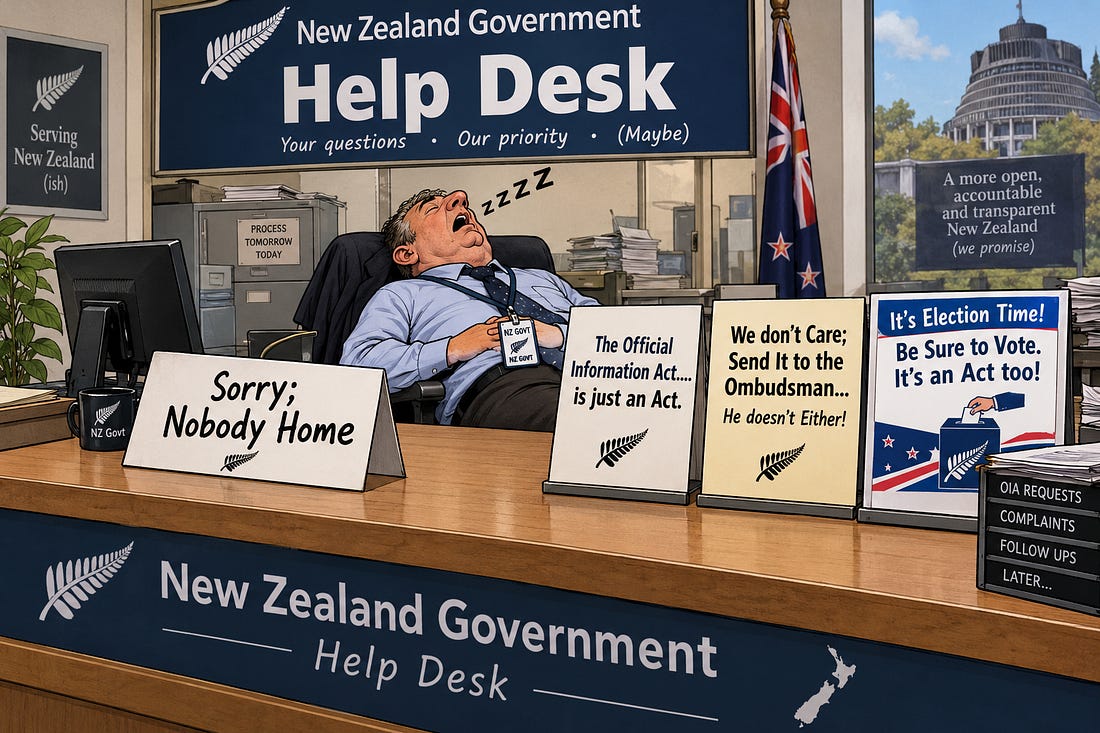
The Official Information Act Has Quietly Broken Down
The Official Information Act Has Quietly Broken Down — And Agencies Are Now Routinely Breaching It
BY NIGEL GRAY INDEPENDENT INVESTIGATOR 12 OCTOBER 2026
 |
Over the past several months I have been documenting a pattern that is no longer anecdotal, no longer isolated, and no longer fixable through the normal accountability channels.
Government agencies across New Zealand are now routinely breaching the Official Information Act, and the watchdog responsible for enforcing the Act — the Ombudsman — has publicly admitted that he is unable to keep up.
Nigel’s Substack is a reader-supported publication. To receive new posts and support my work, consider becoming a free or paid subscriber.

This is not a theory.
This is not speculation.
This is now on the record, through OIA responses from the Ombudsman himself.
And because the Ombudsman is effectively inactive, I am now forced to escalate every breach directly to the Prime Minister’s Office.
This article explains why.
1. Agencies are now routinely making basic OIA errors
Across multiple departments — Ministers’ offices, MPI, Health NZ, Police, DOC, NIWA, RNZ, PMO — the same procedural failures keep appearing:
A. Unlawful transfers (s14 OIA)
Agencies are transferring requests simply because another agency is “involved” in the topic.
This is not the legal test.
The law requires:
a document‑specific assessment
a function‑specific assessment
and retention of parts relating to the Minister’s own functions
Instead, agencies are applying a topic‑based test (“associated with the campaign”), which the Ombudsman has repeatedly ruled is unlawful.
B. Failure to issue lawful extensions (s15A OIA)
Agencies are:
admitting delay
apologising
providing no new date
and failing to issue a formal extension
This is a breach.
The OIA does not allow “floating delays” or “we’ll get back to you when we can.”
MPI’s letter today is a textbook example:
“We acknowledge that we have not yet provided our substantive response…
We are not in a position to provide a firm release date.”
This is not permitted under the Act.
C. Non‑responses disguised as “updates”
Agencies increasingly send:
“We’re working on it”
“We appreciate your patience”
“We will respond as soon as practicable”
None of these are lawful responses.
None of these stop the clock.
None of these satisfy the OIA.
D. Deflection to the Ombudsman
Every agency now ends with the same line:
“If you have concerns, you can complain to the Ombudsman.”
But here is the problem.
2. The Ombudsman has admitted he cannot perform his statutory role
Through an OIA response, the Ombudsman has confirmed:
842 complaints on hand
136 complaints over a year old
delays in allocation
delays in investigation
failure to progress complaints
failure to meet statutory timeliness expectations
He has also admitted that:
complaints are not being allocated
complaints are not being progressed
complainants are waiting over a year
agencies know this
agencies rely on this
This is not a functioning oversight body.
This is a backlog.
And agencies are now using the Ombudsman’s paralysis as cover for their own procedural breaches.
3. My parliamentary petition already seeks an inquiry into the Ombudsman’s failures
Earlier this year, I lodged a parliamentary petition requesting:
an inquiry into Ombudsman delays
an inquiry into ineffective investigations
an inquiry into systemic backlog
an inquiry into the erosion of OIA accountability
That petition is live.
It is published.
It is accepted by Parliament.
The new breaches I am receiving — including today’s MPI breach — directly reinforce the petition’s core claim:
The OIA system is no longer functioning.
4. Because the Ombudsman is effectively inactive, I am forced to escalate every breach to the Prime Minister
This is not a choice.
This is not a tactic.
This is a constitutional necessity.
When:
agencies breach the Act,
agencies refuse to apply the statutory tests,
agencies fail to issue lawful extensions,
agencies delay indefinitely,
and the Ombudsman cannot investigate…
…the only remaining escalation pathway is the Prime Minister’s Office.
This is now the only functioning oversight mechanism available.
Today’s MPI breach has been added to that escalation file.
5. Why this matters for every New Zealander
The OIA is not a niche tool.
It is the backbone of democratic transparency.
When agencies can:
delay indefinitely,
avoid statutory obligations,
misapply legal tests,
and rely on an inactive Ombudsman…
…then the public loses the ability to scrutinise:
ministerial decisions
policy justification
public messaging
risk assessments
internal reasoning
evidence bases
operational failures
This is not a minor administrative issue.
This is a constitutional failure.
6. What happens next
I will continue to:
document every breach
escalate every breach to the PM
update my parliamentary petition
publish each case so the public can see the pattern
map the systemic failures across agencies
expose the structural weaknesses in the OIA system
If the OIA is to remain a meaningful transparency tool, the system must be repaired — not cosmetically, but structurally.