 iSAYSO
The Crown’s Strategic Advantage
Stacking the Odds Against NZ Citizens in the Court Room
How Jury Vetting, Information Asymmetry, and State Privilege Tilt the Scales of Justice
BY NIGEL GRAY 28 SEPTEMBER 2026
Kindly support Nigel he supports us.
 |
Introduction: The Myth of the “Fair Trial”
New Zealanders grow up believing that a jury trial is the gold standard of fairness — twelve ordinary citizens, independent of the state, weighing evidence impartially.
It’s a comforting idea.
It’s also wrong.
Behind the scenes, the Crown enters the courtroom with a structural advantage so significant that most citizens have no idea it exists. The imbalance is not subtle. It is not accidental. It is not theoretical.
It is designed into the system.
This article maps the architecture of that imbalance — how police intelligence, Crown vetting practices, and information asymmetry quietly stack the odds against defendants long before the trial even begins.
1. Jury Vetting: The Crown’s Hidden Weapon
When a jury panel is drawn, both the defence and the Crown receive the same basic list:
names
ages
occupations
On paper, this looks symmetrical.
In practice, it is anything but.
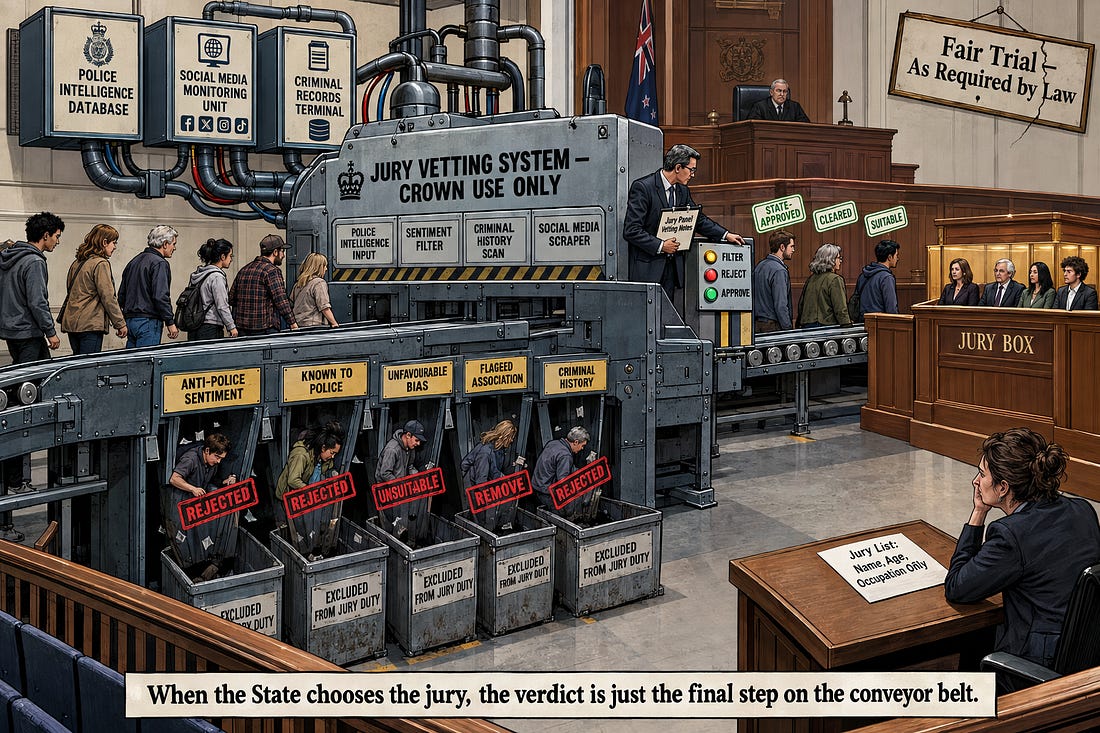
What the Crown receives that the defence does not
Crown prosecutors are legally permitted to access:
criminal histories
police intelligence notes
behavioural flags
association records
NIA (National Intelligence Application) data
any police-held information relevant to “suitability”
This is not speculation.
This is confirmed by Crown Law and upheld by the Supreme Court.
The defence receives none of this.
The result
Before the trial even begins, the Crown can:
identify jurors with anti-police sentiment
identify jurors known to police
identify jurors with past conflicts
identify jurors with criminal histories
identify jurors with social media hostility toward authority
identify jurors with personal connections to the defendant
And then remove them.
The defence cannot perform any equivalent screening.
This is not equality of arms.
This is state-filtered jury construction.
2. The Defence Blindfold
Defence counsel are prohibited from accessing police databases.
They cannot run background checks.
They cannot see intelligence notes.
They cannot detect bias or conflict unless it is openly declared.
They are effectively blind.
This blindness is not incidental — it is structural.
It is built into the legal framework.
The Crown enters jury selection with a telescope.
The defence enters with a blindfold.
3. The Crown’s Strategic Advantage
Under the Juries Act 1981, both sides may challenge jurors:
peremptory challenges (limited)
challenges for cause (unlimited, but must meet criteria)
But only one side knows the causes.
Only one side knows the histories.
Only one side knows the intelligence flags.
Only one side knows the risks.
This allows the Crown to shape the jury in ways the defence cannot detect, cannot counter, and cannot prevent.
The Crown can remove jurors who might favour the defence.
The defence cannot remove jurors who might favour the Crown.
This is not a fair fight.
It is a structurally engineered advantage.
4. The Constitutional Contradiction
A jury is supposed to be:
independent
impartial
representative
free from state influence
But when the state:
vets jurors using police intelligence
filters out unfavourable citizens
withholds information from the defence
shapes the jury composition in advance
…the jury ceases to be independent.
It becomes a state-curated decision-making body.
This undermines:
the presumption of innocence
the legitimacy of the verdict
public confidence in justice
the constitutional integrity of the trial
The contradiction is stark:
The state is both a party to the case and the architect of the jury.
No democratic system should tolerate this.
5. The Public Has No Idea This Happens
Most New Zealanders assume jury selection is neutral.
They assume both sides have equal access to information.
They assume the process is balanced.
They are wrong.
The public does not see:
the police intelligence reports
the vetting notes
the flagged names
the internal communications
the strategic removals
They see twelve citizens sitting in a box.
They do not see the filtering process that determined who those twelve citizens would be.
6. The Real-World Consequences
This imbalance has consequences:
defendants face juries pre-filtered by the state
jurors with anti-police sentiment are quietly removed
jurors sympathetic to defendants may never make it into the box
jurors with police backgrounds may be seated without disclosure
defence counsel cannot detect conflicts of interest
verdicts may reflect state preference rather than community judgment
The system is not neutral.
It is not symmetrical.
It is not balanced.
It is weighted.
7. Why This Matters Now More Than Ever
New Zealand is entering a period of heightened public-police tension:
expanded police powers
increased citizen intervention policies
rising public scrutiny of police conduct
growing distrust in state institutions
In this environment, jury vetting becomes even more consequential.
If the state can quietly remove citizens who distrust police, then trials involving police conduct, police testimony, or police use of force are inherently compromised.
The jury becomes an echo chamber of state-friendly sentiment.
This is not justice.
This is curated compliance.
8. The Core Problem: Information Asymmetry
At the heart of the issue is a simple structural truth:
The Crown knows more about the jury than the defence does.
This violates the principle of equality of arms — a cornerstone of fair trial rights under the NZ Bill of Rights Act.
A fair trial requires:
equal access to information
equal ability to challenge jurors
equal ability to detect bias
equal ability to shape the jury
New Zealand’s system provides none of these.
9. The Solution: Transparency and Symmetry
If New Zealand wants a genuinely fair trial system, it must adopt:
1. Full disclosure of vetting information to the defence
If the Crown sees it, the defence must see it.
2. Prohibition on intelligence-based jury filtering
Criminal histories may be relevant.
Police “sentiment flags” are not.
3. Independent oversight of jury vetting
The state cannot be both participant and gatekeeper.
4. Mandatory disclosure of juror police affiliations
A former police officer should never be seated without defence knowledge.
5. Legislative reform of the Juries Act
The current framework is outdated and structurally biased.
Without reform, the imbalance will continue — quietly, invisibly, and with profound consequences.
Conclusion: The Odds Are Stacked — And Most Citizens Don’t Know It
New Zealanders deserve a justice system that is fair, transparent, and balanced.
What they currently have is a system where the state enters the courtroom with privileged access to intelligence, the ability to filter jurors, and the power to shape the decision-making body before the trial even begins.
The defence enters blind.
The public remains unaware.
And the myth of the “fair trial” continues — comforting, familiar, and false.
Until this imbalance is confronted, New Zealand’s jury system will remain what it is today:
A structurally tilted arena where the Crown plays with loaded dice.