 iSAYSO
There is a particular kind of person whom every powerful institution finds inconvenient.
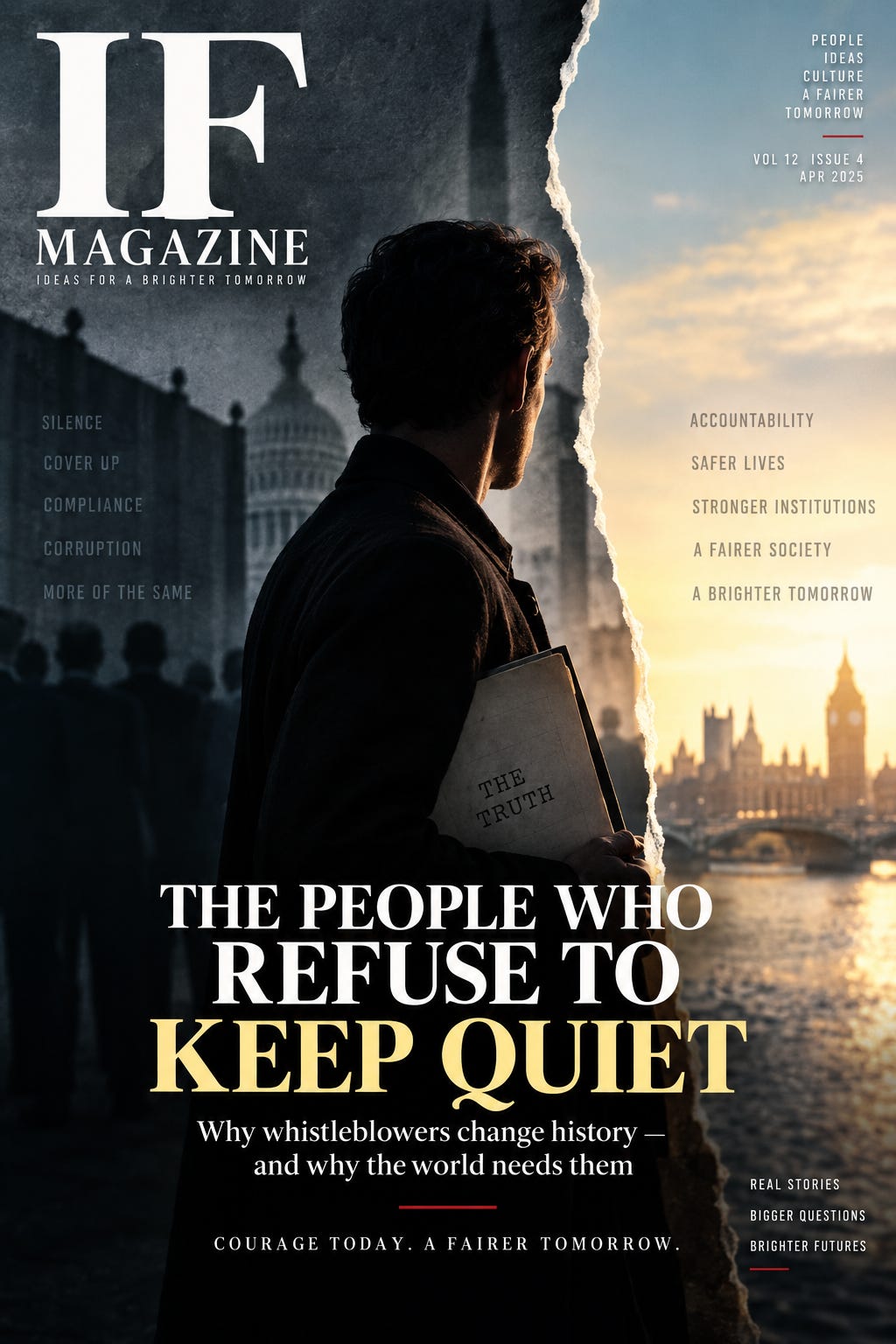
By John Mappin | IF Magazine
There is a particular kind of person whom every powerful institution finds inconvenient.
He is the man who has seen something.
Or the woman who knows something.
Something has happened behind a closed door. A figure has been altered. A law has been circumvented. A patient has been mistreated. Public money has disappeared. An intelligence agency has exceeded its authority. A corporation has discovered that its product is dangerous. A government has told the public one thing while privately knowing another.
And somewhere inside that machine sits an individual confronted with a remarkably simple choice.
Do I keep quiet?
That question has changed history.
We have a rather comfortable habit of celebrating whistleblowers retrospectively. Once the danger has passed and the facts have entered the history books, courage becomes terribly fashionable.
At the time, it rarely feels like that.
At the time the whistleblower is called disloyal, troublesome, unstable, bitter, dishonest or dangerous.
His motives are examined more enthusiastically than his evidence.
His friendships disappear.
His career may disappear with them.
Lawyers arrive.
Sometimes governments arrive.
Yet civilisation depends upon such people.
Not because every whistleblower is right. They plainly are not.
Not because every accusation is true. It plainly is not.
But because any society in which nobody is prepared to contradict power eventually becomes a society in which power no longer needs to tell the truth.
And that is an exceedingly dangerous place.
THE COURAGE TO BREAK RANKS
Consider Daniel Ellsberg.
In 1971 he helped disclose the Pentagon Papers, the classified history of American involvement in Vietnam. They demonstrated an enormous gulf between what successive administrations had understood privately and what the American public had been told.
Ellsberg knew perfectly well what might happen to him.
He nevertheless copied the documents and helped bring them before the public.
Whatever one’s view of the Vietnam War, the principle involved was gigantic.
Should a democratic population be permitted to discover that its government privately possessed information profoundly relevant to a war being conducted in its name?
History answered yes.
Then there was Frank Serpico, the New York policeman who exposed corruption within his own department.
His story contains one of the most uncomfortable features of whistleblowing: the person exposing wrongdoing frequently discovers that the institution is initially more disturbed by the disclosure than by the wrongdoing itself.
Serpico broke the code of silence.
That is what whistleblowers do.
They break codes of silence.
And codes of silence can become extraordinarily powerful because everybody inside them has an incentive to maintain them.
One person says nothing because his pension depends upon it.
Another says nothing because his promotion depends upon it.
Another says nothing because his friend is involved.
Another because he fears embarrassment.
Another because he assumes somebody else will speak.
Soon hundreds of perfectly ordinary people are participating in something none of them individually would have created.
Then one person stands up.
The spell is broken.
WATERGATE
Perhaps the most celebrated example is Watergate.
Information provided by the confidential source later revealed as FBI official Mark Felt — “Deep Throat” — helped Washington Post reporters Bob Woodward and Carl Bernstein pursue a scandal that ultimately reached the Nixon White House.
But imagine the alternative history.
Imagine everybody had remained silent.
Imagine the burglars had said nothing.
Imagine officials had said nothing.
Imagine journalists had stopped asking questions.
Richard Nixon might have completed his presidency without the full machinery of Watergate ever being understood by the American public.
More importantly, a precedent would have been established.
The lesson for future administrations would have been brutally simple:
You can get away with it.
That is the part of whistleblowing we underestimate.
The revelation does not merely correct yesterday.
It alters tomorrow.
THE TWO FUTURES
Every whistleblower therefore stands at the entrance to two possible futures.
In the first, he speaks.
His own life may become considerably more difficult.
He may lose friends.
He may lose employment.
He may discover that people who previously praised his integrity suddenly regard integrity as a deeply irritating characteristic.
But something else happens.
The information enters the bloodstream of society.
Journalists investigate.
Documents are examined.
Courts become involved.
Parliaments ask questions.
Boards investigate.
Officials become accountable.
Sometimes laws change.
Sometimes people are compensated.
Sometimes institutions reform themselves.
And sometimes millions of people who will never know the whistleblower’s name live in a slightly freer or safer world because one human being decided not to remain silent.
Now consider the second future.
He says nothing.
At first this appears much easier.
The salary continues.
The invitations continue.
The colleagues remain friendly.
Nobody calls him mad.
Nobody threatens him with lawyers.
Nobody searches his past for embarrassing photographs.
He goes home and pours himself a glass of wine.
Everything is peaceful.
Except that he knows.
And the institution knows that people like him will remain silent.
So the misconduct continues.
Perhaps it grows.
The small lie becomes the large lie because nothing happened when the small lie was told.
The £10,000 fraud becomes the £10 million fraud.
The concealed accident becomes a concealed policy.
The exceptional abuse becomes standard procedure.
And gradually something rather more important than one man’s career is lost.
The culture’s immune system has failed.
WHAT IF NOBODY HAD SPOKEN?
Imagine a world without whistleblowers.
Imagine there had been no Pentagon Papers.
No Watergate sources.
No corporate insiders exposing dangerous practices.
No police officers exposing corruption.
No civil servants prepared to tell legislators that something was wrong.
No scientists prepared to contradict their employers.
No employees prepared to produce the inconvenient document.
No witnesses prepared to say:
“That isn’t what happened.”
Such a world might initially appear remarkably orderly.
Governments would issue statements.
Corporations would publish reports.
Institutions would congratulate themselves.
Everyone would behave professionally.
And almost none of it could be independently challenged from inside.
That is not order.
It is the architecture of unaccountable power.
The twentieth century taught us where that road can lead.
Almost every great institutional scandal depends, somewhere along the line, upon silence.
Somebody knew.
Usually several people knew.
The catastrophe was possible because knowing and speaking had become two entirely different things.
THE PRICE
We should therefore understand the peculiar bargain society makes with whistleblowers.
We benefit from them while frequently making their lives miserable.
That is not terribly honourable.
There must of course be safeguards.
An accusation is not proof.
A whistleblower should not possess some magical immunity from scrutiny merely because he claims virtuous motives.
Evidence matters.
Due process matters.
The rights of the accused matter.
False allegations can destroy lives just as surely as concealed wrongdoing can.
But none of those principles requires silence.
Quite the reverse.
A mature society should be capable of doing two things simultaneously:
protecting the right to speak and demanding evidence for what is said.
That is the civilised position.
THE CONSCIENCE OF THE MACHINE
Large institutions are peculiar organisms.
They do not possess consciences.
People do.
A government department cannot wake at three o’clock in the morning troubled by what it has done.
A corporation cannot feel shame.
An intelligence service cannot experience remorse.
Only the human beings inside them can do that.
Which means that ultimately every system of accountability comes down to individual conscience.
Rules matter.
Auditors matter.
Regulators matter.
Courts matter.
Journalists matter.
But before any of them can act, somebody often has to say:
“Look here.”
That may be the most important sentence in public life.
Look here.
Look at this document.
Look at these figures.
Look at what actually happened.
Look at what we were told to do.
Look at the difference between the public statement and the private memorandum.
The whistleblower forces society to look.
THE PERSONAL FUTURE
There is another aspect to this which is rarely discussed.
What happens to the person who does not speak?
We naturally concentrate upon the consequences suffered by those who do.
But silence has consequences too.
Imagine knowing that innocent people were being harmed and choosing comfort.
Imagine knowing that public money was being stolen and saying nothing.
Imagine discovering that an institution in which you believed had betrayed its principles and deciding that your mortgage mattered more.
Perhaps nobody else would ever know.
But you would.
There are prisons made of brick.
And there are prisons made of memory.
The whistleblower may lose his job and keep himself.
The silent man may keep his job and gradually lose something considerably more valuable.
That is why genuine whistleblowing is ultimately a question of character.
CIVILISATION’S ALARM BELL
A fire alarm is an irritating object.
Nobody enjoys hearing one.
It interrupts dinner.
It wakes people up.
It causes confusion.
Occasionally it goes off when there is no fire at all.
But nobody sensible concludes that buildings would therefore be safer without fire alarms.
Whistleblowers are civilisation’s fire alarms.
Sometimes mistaken.
Sometimes difficult.
Sometimes personally complicated.
Frequently inconvenient.
But absolutely necessary.
Because the alternative is a civilisation in which smoke fills the corridors while everybody politely continues with dinner.
We should therefore be extremely careful when powerful people tell us that someone should have remained silent.
Perhaps they should have.
Perhaps the allegation is false.
Perhaps the evidence does not withstand examination.
But perhaps the person telling us to ignore the alarm is standing rather close to the fire.
The answer is not to destroy the alarm.
The answer is to investigate the smoke.
And history suggests that many of the freedoms we now take entirely for granted exist because, at some decisive moment, one frightened, stubborn and extraordinarily inconvenient human being decided that silence was no longer an acceptable option.
Civilisation owes rather more to such people than civilisation generally likes to admit.