 iSAYSO
What Your Government Is Hiding From You
Nigel’s Substack
What Your Government Is Hiding From You
By Nigel Gray — Independent Investigator 3 September 2026
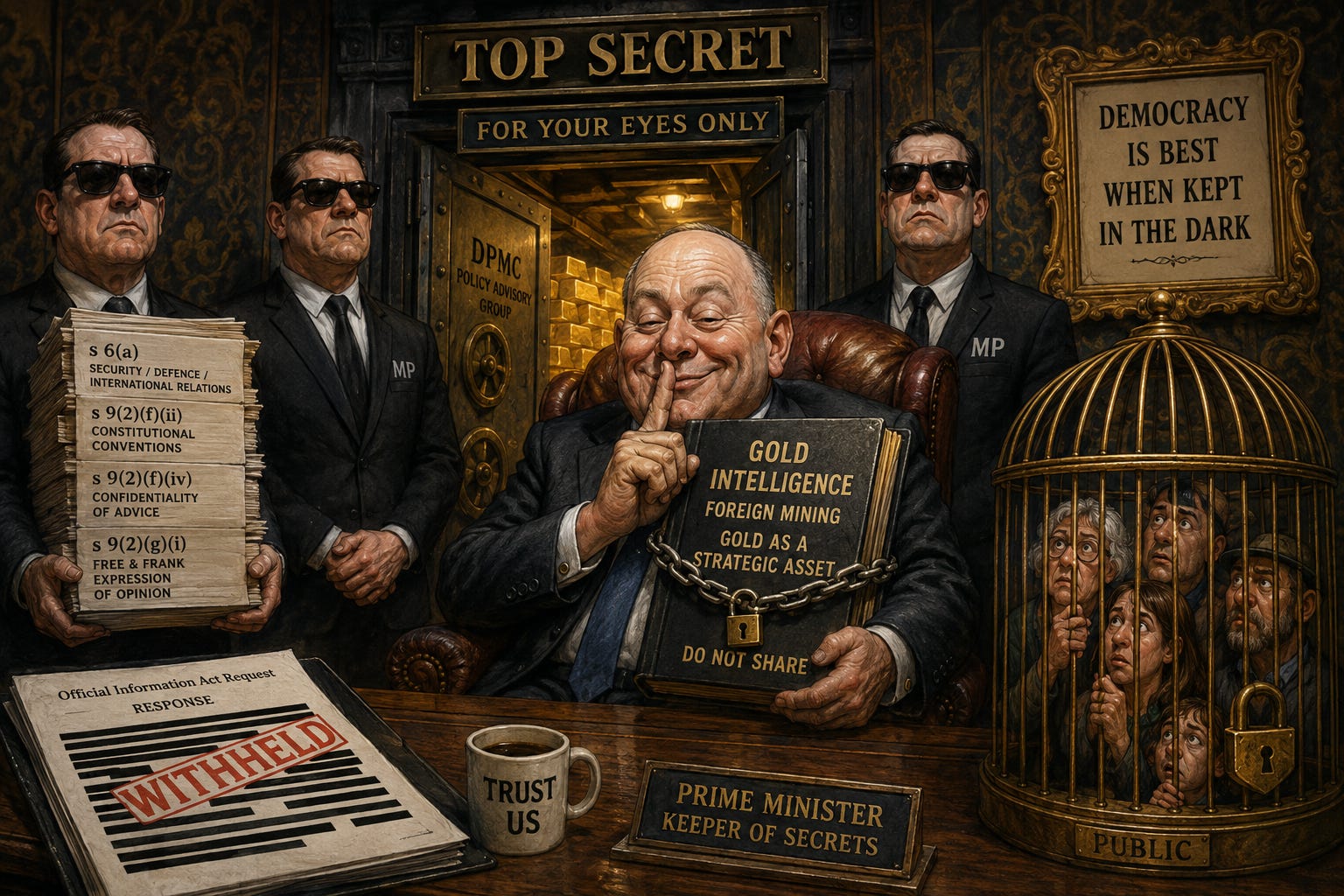
Introduction: The Silence Around Gold
When a government refuses to answer a question, that’s one thing.
When a government confirms the existence of strategic briefings — then refuses to release a single sentence — that’s something else entirely.
Recently, the Department of the Prime Minister and Cabinet (DPMC) responded to my Official Information Act request about gold: specifically, whether New Zealand considers gold a strategic national asset, and whether Cabinet has been briefed on sovereignty risks arising from foreign‑owned extraction.
Their answer was simple:
“We have briefed the Prime Minister. You cannot see any of it.”
And that should concern every New Zealander.
The First Red Flag: Strategic Briefings Exist
Halfway through the letter, DPMC admits:
“Identified as relevant… are some briefings provided by the DPMC Policy Advisory Group to the Prime Minister.”
This is not trivial.
It means:
DPMC has conducted strategic analysis on foreign‑owned extraction of minerals.
The Prime Minister has been formally briefed.
The topic is significant enough to reach the highest levels of government.
Gold is not being treated as a mere commodity.
It is being treated as a strategic risk.
The Second Red Flag: Total Withholding
DPMC did not release:
a summary
a paragraph
a sentence
a title
or even a date
They withheld the briefings in full, using the strongest protections available under the OIA:
6(a) — national security
9(2)(f)(ii) — constitutional conventions
9(2)(f)(iv) — confidentiality of ministerial advice
9(2)(g)(i) — free and frank expression
These are not used for trivial matters.
They are used when disclosure would reveal:
geopolitical vulnerabilities
foreign influence
strategic resource exposure
or Cabinet‑level disagreements
This is not “routine withholding.”
This is strategic silence.
The Third Red Flag: The Contradiction
DPMC claims:
“No information exists”
for Parts 1 and 2 — the sections asking about sovereignty risks and gold as a strategic asset.
But Part 4 — which asks about exposure to foreign‑owned extraction — does have information.
And that information is withheld.
You cannot have:
exposure assessments
without
sovereignty risk analysis.
You cannot have:
strategic briefings
without
strategic framing.
The contradiction is the tell.
It is the bureaucratic equivalent of saying:
“We didn’t do the analysis you asked about — but we did the analysis you asked about.”
The Fourth Red Flag: The Timeframe Trap
Because I did not specify a timeframe, DPMC imposed one:
“27 November 2023 to 11 August 2026.”
This is a containment tactic.
It prevents scrutiny of:
earlier Cabinet thinking
historical policy development
long‑term strategic modelling
previous governments’ positions on gold
It is a way of saying:
“We will answer your question — but only in the narrowest possible way.”
What This Means for New Zealand
The government has now confirmed:
Gold is being discussed at the highest levels of government.
Foreign ownership of gold extraction is considered strategically sensitive.
The Prime Minister has received briefings on exposure risks.
Those briefings are too sensitive to release.
The public interest is not considered sufficient to justify transparency.
This is not about gold.
This is about what your government believes you should not know.
The Real Question
If the briefings contain nothing alarming, nothing controversial, and nothing strategically sensitive…
why are they being withheld under national security grounds?
If the analysis does not exist…
why does the Prime Minister have briefings on the topic?
If the public interest is insufficient…
who decides what the public should be allowed to understand about its own resources?
Conclusion: The Silence Speaks
Governments rarely hide information because it is boring.
They hide information because it is important.
The DPMC response is not a denial.
It is an admission — wrapped in a refusal.
New Zealanders deserve to know how their strategic assets are being managed, who controls them, and what risks are being quietly acknowledged behind closed doors.
Until then, the only honest title for this story is:
What Your Government Is Hiding From You.