 iSAYSO
Ombudsman
Nigel’s Substack
Ombudsman Office Not So “Independent”!
Are Ombudsman’s Office Protecting Police and Minister of Police?
When Oversight Fails: How the Ombudsman Responded to My DrugWipe Inquiry
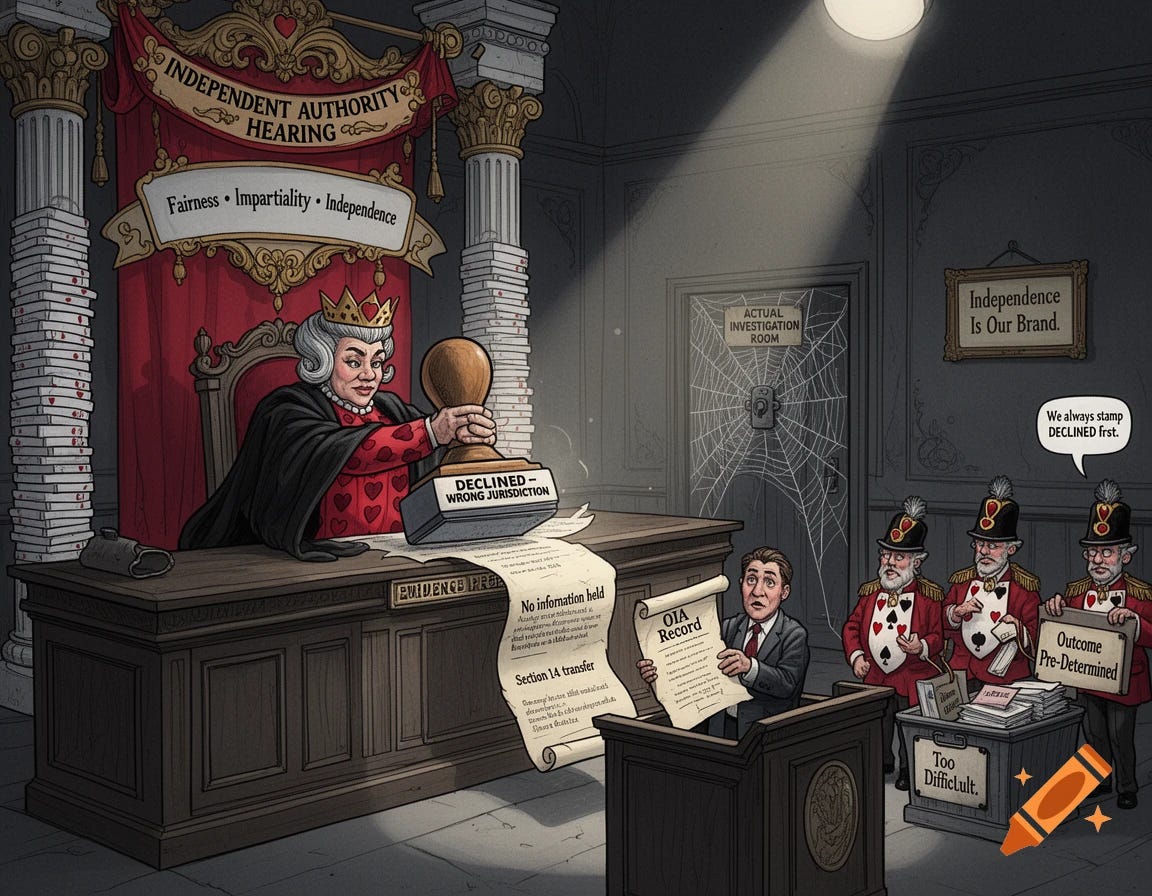
On 7 July I received a reply from the Office of the Ombudsman regarding my complaint about contradictory statements made by the Minister of Police about DrugWipe 3S. I will include the letter itself with this article, but the short version is this:
The Ombudsman declined to investigate — not because the issue lacks merit, but because they reframed the complaint into something they could safely avoid.
This article explains what I received, what the Ombudsman chose not to address, and how we have responded.
What I asked the Ombudsman to examine
My complaint was simple and strictly within the Official Information Act (OIA):
The Minister of Police has repeatedly claimed that DrugWipe 3S has “20 years of safe use”.
Police cannot provide evidence for this claim.
The Minister’s office transferred my OIA request under section 14, stating they hold no such information.
Despite this, the Minister publicly repeated the claim two days later.
This is an OIA inconsistency problem:
the public statements of a Minister contradict the official information record.
Ministers are subject to the OIA.
The Ombudsman is responsible for reviewing OIA compliance.
That is the entire issue.
What the Ombudsman said instead
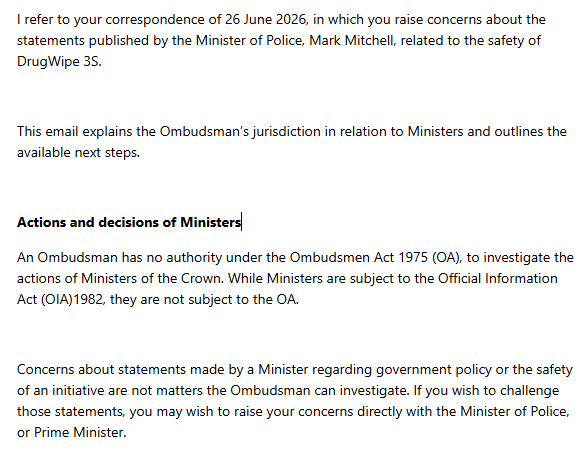
The Ombudsman’s reply did not address the contradiction.
Instead, they reframed my complaint as:
“Concerns about statements made by a Minister regarding government policy”, and
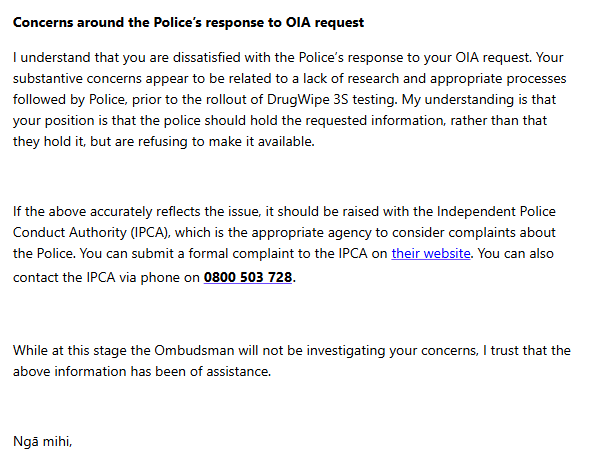
“Concerns about Police processes prior to the rollout of DrugWipe 3S”.
Neither of these reflects what I actually raised.
By reframing the issue, the Ombudsman could then say:
They cannot investigate Ministers under the Ombudsmen Act, and
I should take Police‑related concerns to the Independent Police Conduct Authority (IPCA).
This is a procedural sidestep.
It avoids the OIA dimension entirely.
Understanding the Difference: OA vs OIA
Because the Ombudsman’s reply leans heavily on jurisdiction, it’s important to explain the difference between the two Acts they rely on:
Ombudsmen Act 1975 (OA)
The OA governs what the Ombudsman can investigate in terms of administrative conduct.
Under the OA:
The Ombudsman can investigate government departments and agencies.
The Ombudsman cannot investigate Ministers of the Crown.
This limitation is real — but it is also irrelevant to my complaint.
Official Information Act 1982 (OIA)
The OIA governs access to official information and the obligations of agencies and Ministers to:
hold information,
transfer requests correctly,
provide accurate responses, and
ensure public statements align with the information actually held.
Crucially:
Ministers ARE subject to the OIA.
The Ombudsman DOES have jurisdiction over OIA complaints involving Ministers.
My complaint is about OIA compliance, not Ministerial actions under the OA.
The Ombudsman’s reply conflates the two Acts — and by doing so, they avoid engaging with the contradiction between the Minister’s public statements and the OIA record.
This is the core problem.
Why this matters
The Ombudsman’s office is the only independent body empowered to review:
whether a Minister’s office correctly handled an OIA request,
whether information is being withheld or misrepresented, and
whether public statements are consistent with the information actually held.
Redirecting an OIA contradiction to the IPCA — which has no jurisdiction over OIA matters — is not a solution. It is a deflection.
The public deserves clarity when official statements and official records diverge.
How we responded
I have sent a jurisdiction‑challenge clarification to the Ombudsman, restating the actual issue:
This is not a complaint about policy.
This is not a complaint about Police operational processes.
This is an OIA inconsistency involving the Minister’s office.
Ministers are subject to the OIA.
The Ombudsman does have jurisdiction over OIA compliance.
The clarification requests a formal reconsideration.
Why I’m publishing this
Transparency matters — especially when oversight bodies appear reluctant to engage with contradictions between public claims and official records.
Publishing this exchange ensures:
the public can see how oversight mechanisms respond,
the reasoning used to decline scrutiny is visible, and
the process remains accountable.
The attached image shows the Ombudsman’s letter exactly as received.
Next steps
Depending on the Ombudsman’s reconsideration, the next moves may include:
[ REDACTED! POLICE HAVE ALREADY INFORMED ME THEY ARE READING MY POSTS SO WE ARE NOT GOING TO HAND OUT OUR NEXT MOVES! SORRY BOYS; IF YOU CAN REDACT, SO CAN I! ]