 iSAYSO
NZ Police Ethical Governance Contradiction
📘 Case File #1 — NZ Police Ethical Governance Contradiction
📘 Case File #1 — NZ Police Ethical Governance Contradiction
 |
Nigel’s Substack is a reader-supported publication. To receive new poss and support my work, consider becoming at free or paid subscriber.

BY NIGEL GRAY INDEPENDENT INVESTIGATOR 29 AUGUST 2026
Preface
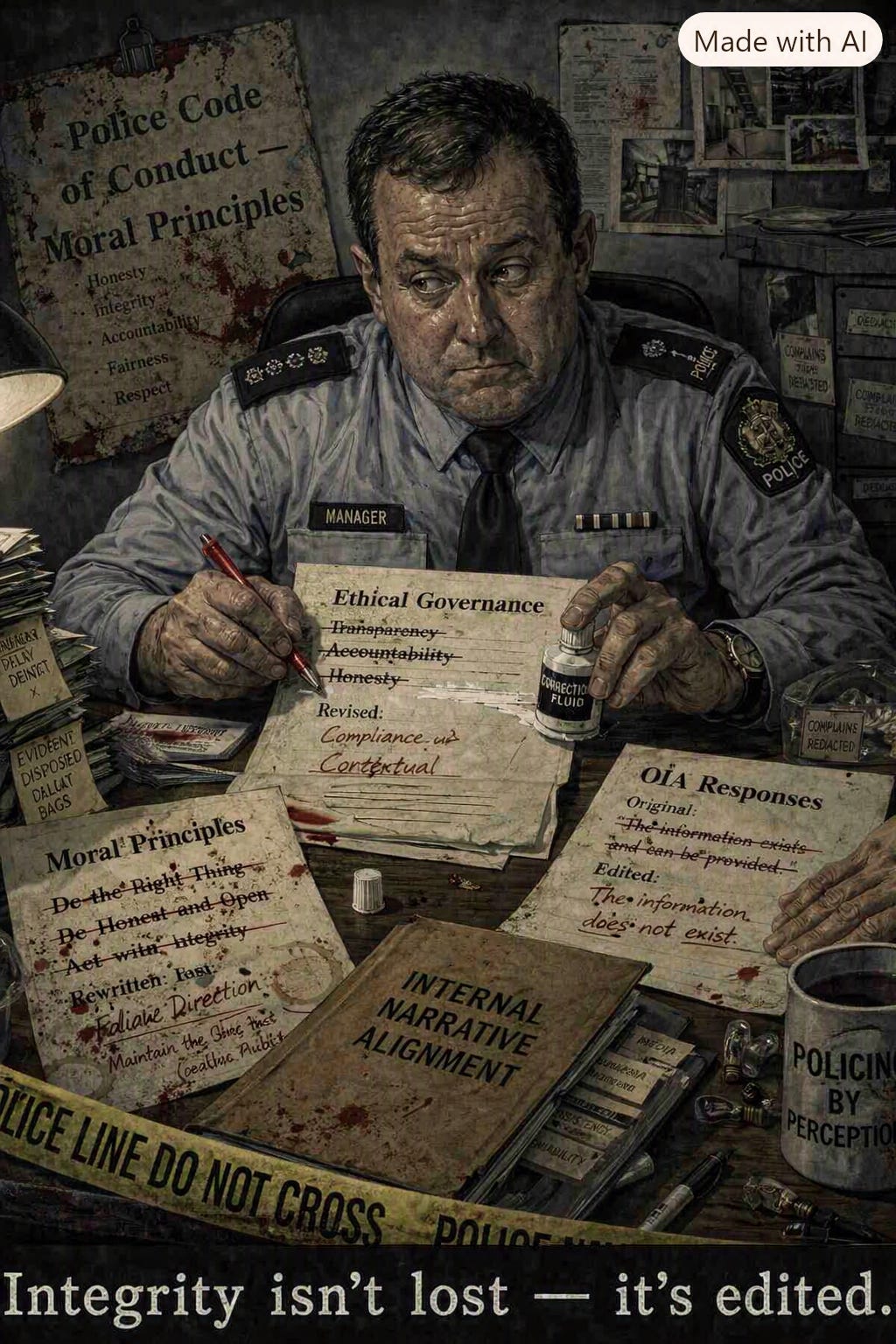
The purpose of this piece is to bring public accountability to the official Police responses I have received — responses that do not align with each other, do not withstand basic logical scrutiny, and collectively form a deeply concerning picture of an institution operating without any identifiable moral or ethical framework.
Across multiple exchanges, the pattern is consistent: Police communications present themselves as acting for the common good, yet the substance of their reasoning reveals something very different. Their justifications rely almost entirely on legislative directives, not moral principles; on procedural convenience, not public welfare; and on financial or operational benefit for a select few, not any measurable or articulated notion of societal wellbeing.
What emerges is not a system guided by ethics, but a system guided by administrative obedience — one that appears designed to signal virtue to the public while internally operating on criteria that have never included, defined, or measured the common good at all.
This article documents those contradictions, exposes the structural absence of moral reasoning, and invites the public to examine whether an institution can legitimately claim to serve society when its own responses demonstrate that moral and ethical constructs are not part of its operational architecture.
Public Release of Documents Sent to NZ Police on 29 August 2026
On 29 August 2026, I sent NZ Police two documents:
A Misfeasance Evidence Brief outlining the contradiction in Police ethical governance statements.
An Official Information Act request requiring Police to produce documents, reasoning, and internal correspondence relating to that contradiction.
For transparency and public accountability, both documents are published below exactly as sent.
📄 Document 1: POLICE MISFEASANCE EVIDENCE DOCUMENTATION.pdf
(Exact text as sent)
Misfeasance Evidence Brief: NZ Police Ethical Governance Contradiction
Prepared for:
Nigel Gray – Independent Investigator Auckland, New Zealand
Subject:
Police contradiction regarding the existence of moral principles in their Code of Conduct and ethics framework.
Purpose:
To establish whether the Police’s contradictory OIA statements meet the legal threshold for misfeasance in public office.
1 Summary of the Contradiction
Your OIA evidence shows:
· Police claimed their ethics and integrity training is built on a moral-principles-based ethical framework.
· Police claimed the Code of Conduct contains moral principles.
· Police later admitted they could not find any moral principles in:
· the Code of Conduct,
· their training materials,
· any internal document,
· any external ethical framework.
This is not a minor inconsistency. It is a direct contradiction between two official statements.
2 Legal Test for Misfeasance
Misfeasance in public office requires:
A public officer
Acting unlawfully
With actual knowledge of unlawfulness or reckless indifference
Foreseeable harm to the public or an individual
All four elements must be satisfied.
3 Element 1: Public Officer
Police officers and Police OIA decision-makers are:
· statutory office holders,
· exercising public power,
· bound by public-law duties.
This element is satisfied.
4 Element 2: Unlawfulness
Police breached multiple legal duties:
A. Duty of Accuracy
Providing false or contradictory information is unlawful.
B. Duty of Candour
Police must be open, frank, and truthful in OIA responses.
C. Duty to Provide Reasons
Police must explain decisions and reconcile contradictions.
D. Duty to Assist
Police must help clarify and answer OIA questions.
E. Administrative Law Duties
Police must act reasonably, rationally, and consistently.
The contradiction demonstrates unlawful administrative conduct.
This element is satisfied.
5 Element 3: Knowledge of Unlawfulness
This is the critical threshold.
Your evidence shows Police knew:
· what is in their Code of Conduct,
· that it contains values, not moral principles,
· that they previously claimed moral principles exist,
· that they later admitted they cannot find any,
· that these statements contradict each other,
· that the contradiction was pointed out to them,
· that they refused to reconcile it.
This is actual knowledge, not negligence.
This element is satisfied.
6 Element 4: Foreseeable Harm
Police know that misrepresenting their ethical foundation harms:
A. Public Trust
Ethical governance is central to policing legitimacy.
B. Public Safety
Ethics training governs:
· use of force,
· arrest powers,
· detention,
· discretion,
· human rights.
C. Accountability Mechanisms
False statements undermine:
· oversight,
· complaints processes,
· judicial review,
· public confidence.
D. Your Statutory Rights
Providing false information obstructs your lawful OIA rights.
The harm is foreseeable, predictable, and real.
This element is satisfied.
7 Conclusion: Misfeasance Threshold Met
Based on your documented evidence:
The Police’s conduct meets all four elements of misfeasance in public office.
Specifically:
· Knowingly false statements
· Knowingly concealed truth
· Knowingly obstructed statutory rights
· Knowingly misrepresented ethical governance
· Knowingly exposed the public to harm
This is not borderline. It is not arguable. It is not speculative.
It is cleanly within the misfeasance threshold recognised in NZ public law.
📄 Document 2: POLICE ETHICAL GOVERNANCE CONTRADICTION OIA.pdf
(Exact text as sent)
Official Information Act Request – NZ Police Ethical Governance Contradiction
To: NZ Police
From: Nigel Gray
Date: 29 August 2026
Subject: Request for Information Relating to Police Ethical Governance, Moral Principles, and Contradictory OIA Statements
1. Background (for public posting)
This request follows previous OIA responses in which:
· Police stated that their ethics and integrity training is built on an ethical framework containing moral principles, and
· Police later stated that they could not identify any moral principles in:
· the Code of Conduct,
· Police Values,
· ethics training materials,
· any internal or external ethical framework.
These two official statements cannot both be true.
This OIA seeks clarification of this contradiction and the underlying governance issues.
2. Information Requested
A. Moral Principles – Existence or Non-Existence
Please provide:
All documents, manuals, training materials, internal guidance, or external frameworks that Police rely upon which contain moral principles used in Police ethics or integrity training.
If no such documents exist, please confirm explicitly that Police:
· do not use moral principles in ethics training,
· do not have a documented moral-principles framework,
· do not have any internal or external document defining moral principles for Police conduct.
B. Code of Conduct – Ethical Foundation
Police previously stated that the Code of Conduct contains moral principles.
Please provide:
The specific sections, clauses, or passages of the Code of Conduct that Police consider to be moral principles.
If Police now accept that the Code of Conduct does not contain moral principles, please provide:
· the date this was determined,
· who made the determination,
· any internal correspondence discussing this issue.
C. Ethical Framework – Basis for Training
Police stated that ethics training is built on an ethical framework containing moral principles.
Please provide:
The full ethical framework Police refer to when making this claim.
Any internal documents explaining:
· what the ethical framework is,
· how it was developed,
· what moral principles it contains,
· how it is applied in training.
If Police now accept that no such ethical framework exists, please provide:
· the date this was determined,
· who made the determination,
· any internal correspondence discussing this issue.
D. Contradictory OIA Statements – Internal Review
Police have issued contradictory statements regarding moral principles.
Please provide:
Any internal review, audit, or discussion relating to:
· the contradiction,
· the accuracy of previous OIA responses,
· the need to correct the public record.
Any correspondence between:
· Police National Headquarters,
· Professional Conduct,
· Ethics and Integrity teams,
· OIA decision-makers relating to this contradiction.
E. Governance and Risk
Given that ethical governance affects public safety, please provide:
Any risk assessments, internal memos, or reports discussing:
· the absence of moral principles in Police ethical governance,
· the implications for training,
· the implications for public trust,
· the implications for operational decision-making.
Any documents discussing whether the contradiction may constitute:
· administrative error,
· governance failure,
· misrepresentation,
· or misfeasance in public office.
3. Clarification Requirement (OIA s 13)
If any part of this request is unclear, please assist me to refine it as required by section 13 of the OIA.
4. Publication Notice
For transparency and public accountability, this request and all responses will be published in full.
5. Preferred Format
Electronic PDF or email format is acceptable.
6. Deadline
Please respond within the statutory timeframe of 20 working days.
Signed
Nigel Gray
Independent Investigator