 iSAYSO
The Collapse of Psychiatry in NZ Dressed Up as a Mental Health Crisis
The Collapse of Psychiatry in NZ Dressed Up as a Mental Health Crisis Who Really Owns Your Mind?
The Collapse of Psychiatry in NZ Dressed Up as a Mental Health Crisis
Who Really Owns Your Mind?
BY NIGEL GRAY INDEPENDENT INVESTIGATOR 29 AUGUST 2026
Key Extract
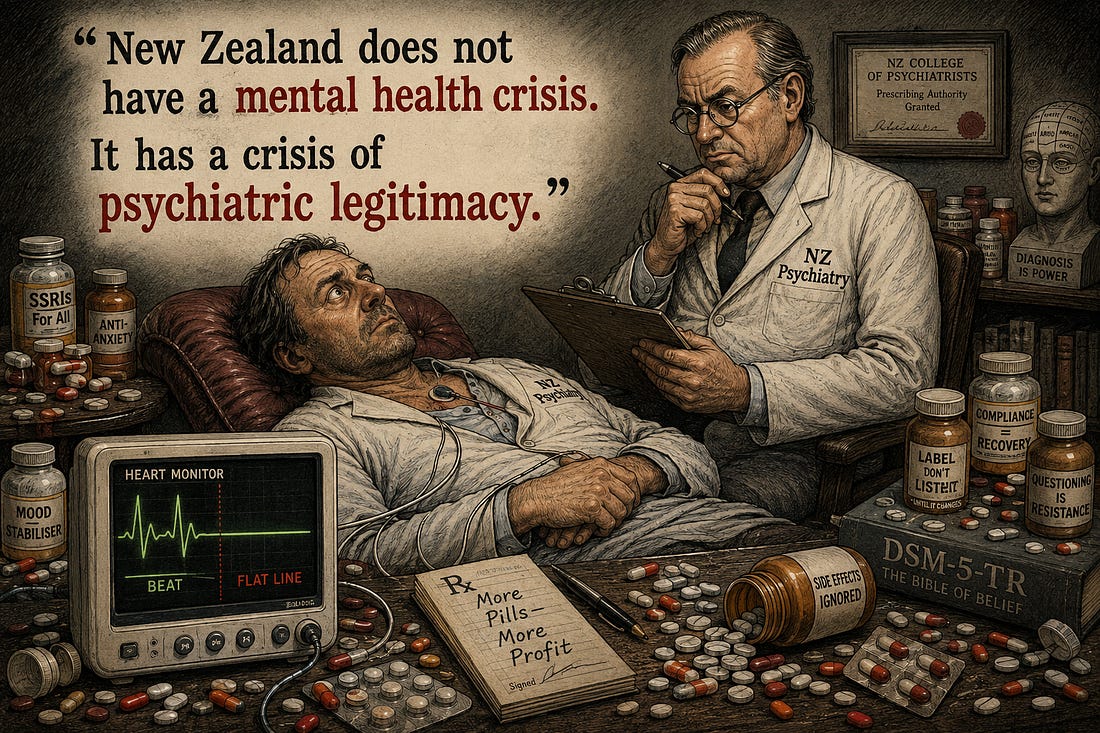 |
“New Zealand does not have a mental health crisis.
It has a crisis of psychiatric legitimacy.”
1. The Headline That Lied
A national broadcaster warns of a “mental health crisis looming.”
Nigel’s Substack is a reader-supported publication. To receive new posts and support my work, consider becoming a free or paid subscriber.

But the evidence presented does not describe a crisis in the minds of New Zealanders.
It describes a crisis in the psychiatry workforce — a profession struggling to staff itself, sustain itself, and justify itself.
The headline is not merely inaccurate.
It is a strategic misdirection, a rhetorical shield for a collapsing institution.
“When a profession fails, it often reframes its own decline as a threat to society.”
2. What the Article Actually Says (Once You Strip the Spin)
The underlying facts point to a profession in freefall:
Retirement cliffs
Vacant psychiatry positions
Training bottlenecks
Supervision shortages
Declining access to specialist services
Institutional disagreement
Calls for more money, more beds, more staff
This is not a mental health crisis.
It is a labour‑market failure inside psychiatry.
The public’s mental wellbeing is not collapsing.
Psychiatry is.
For deeper analysis: psychiatry’s collapse.
Key Extract
“The public is told they are unwell, when the profession is the one in trouble.”
3. The Great Seizure of the High Ground
To understand why psychiatry can make such claims, you must understand the territory it has quietly colonised.
Psychiatry has spent decades expanding into domains that were never medical:
Religion — spiritual experience reframed as pathology
Philosophy — meaning and purpose treated as clinical material
Community norms — deviation pathologised
Personal agency — responsibility replaced with diagnosis
Moral reasoning — conscience reinterpreted as chemical imbalance
This is the illegitimate seizure of the high ground — a profession claiming authority over the mind, the soul, and the moral life of individuals.
“Psychiatry did not earn this territory. It annexed it.”
4. The Category Error at the Heart of Psychiatry
Psychiatry claims expertise in the mind.
But its tools operate on the brain.
This is the central contradiction:
Drugs that interfere with cognition
ECT that induces seizures and memory loss
Diagnostic labels describing behaviour, not mechanisms
No scientific model of consciousness
No measurable definition of “mental health”
Psychiatry treats the brain while legislating the mind.
This is not science.
It is a category error with victims.
For deeper critique:
mental health as a medical construct.
Key Extract
“Psychiatry treats the brain while claiming dominion over the mind.”
5. “Mental Health” as a Tool of Jurisdiction
“Mental health” is presented as if it were equivalent to physical health — measurable, objective, clinical.
It is not.
Physical health has metrics: blood pressure, infection markers, organ function.
“Mental health” is a constructed category used to justify medical authority over:
belief
emotion
meaning
purpose
identity
suffering
moral conflict
existential crisis
The public has been conditioned to believe their inner life is a medical matter.
This is not science.
It is jurisdiction.
6. The Existing Care Sector Already Handles Impaired Reasoning
New Zealand already has:
private trusts
charitable organisations
disability care providers
elder care facilities
supported living services
These entities care for people with compromised reasoning powers without claiming ownership of the mind.
But even they often lack:
human rights literacy
dignity frameworks
moral‑intent principles
philosophical grounding in care ethics
This highlights the real issue:
The crisis is not in the public’s mental wellbeing.
It is in the absence of moral and philosophical competence across the care sector — psychiatry included.
Key Extract
“The problem is not the public’s mental health — it is the absence of moral competence in the care sector.”
7. The Real Crisis: Psychiatry’s Legitimacy Is Failing
The profession faces:
workforce collapse
public distrust
unresolved historical harm
continued use of ECT
over‑medicalisation of normal life
diagnostic inflation
lack of scientific foundation
institutional self‑preservation
failure to understand the mind
encroachment into moral and spiritual domains
And here is where the historical quote fits perfectly.
As Brock Chisholm, first Director‑General of the WHO, admitted:
“We have not yet discovered a good way to understand the human mind.”
This is psychiatry’s own leadership acknowledging the profession’s foundational ignorance — even as it claims authority over the most intimate domain of human existence.
8. Who Really Owns Your Mind?
This is the question psychiatry cannot afford the public to ask.
If the mind is:
a spiritual domain
a philosophical domain
a moral domain
a community domain
a personal domain
Then psychiatry loses its jurisdiction.
If the mind is not a medical object, psychiatry loses its power.
If the mind belongs to the individual, psychiatry loses its authority.
The RNZ headline is not about public wellbeing.
It is about protecting a profession that has claimed ownership of something it cannot define, cannot measure, and cannot heal.
Key Extract
“The mind belongs to the individual — not the institution, and certainly not the profession currently collapsing under the weight of its own contradictions.”