 iSAYSO
Roadside Drug testing, there are lots of questions still to be answered by OIAs
PART TWO — THE LOOP SYSTEM: How Government Programmes Become Self‑Feeding Machines
By Nigel Gray 23 AUGUST 2026
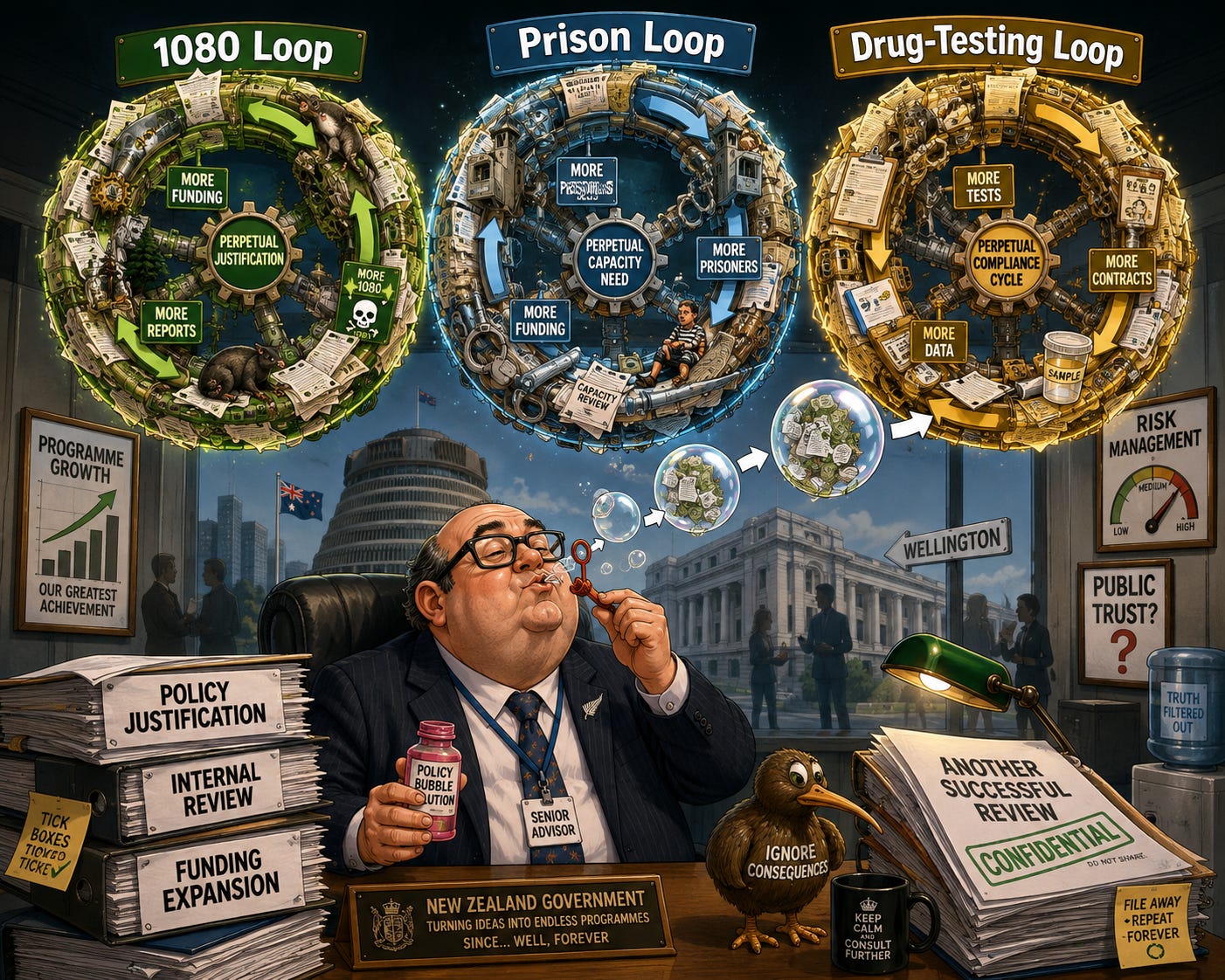
The drug‑testing investigation revealed something far larger than a single flawed system.
It revealed a pattern.
A structural behaviour repeated across multiple government programmes — regardless of the domain, the agency, or the political party in power.
It is the pattern of the closed loop.
A loop is created when a government agency or Crown‑controlled organisation:
defines the problem,
designs the policy response,
implements the response,
enforces the response,
evaluates its own performance,
profits from the continuation of the programme,
and uses its own data to justify expanding the programme.
This is not independent oversight.
This is not accountability.
This is not separation of powers.
It is a self‑feeding machine.
And New Zealand has several of them.
1. The 1080 Loop
A Crown‑owned company manufactures 1080.
Government policy mandates its use.
Government agencies drop it.
Government protocols prevent detection of 1080 wildlife deaths.
Government narratives justify more 1080.
Government receives the profits.
The same system that creates the problem is the system that benefits from the solution.
A closed loop.
2. The Prison System Loop
Corrections defines the “risk”.
Corrections designs the rehabilitation programmes.
Corrections delivers the programmes.
Corrections evaluates its own success.
Corrections uses its own data to justify more funding.
Corrections expands the same programmes.
The same agency responsible for the problem is responsible for proving it solved the problem.
A closed loop.
3. The Drug‑Testing Loop (from Part One)
PHF Science (formerly ESR) helped design the drug‑driving regime.
PHF Science advised on thresholds.
PHF Science co‑developed Police drug‑detection technology.
PHF Science is the statutory laboratory.
PHF Science performs the evidential testing.
PHF Science earns millions from the programme.
PHF Science produces the data used to justify future legislative changes.
The same organisation that designs the system profits from the system and evaluates the system.
A closed loop.
The Pattern Is Now Clear
Across these domains, the same structural DNA appears:
The agency benefits from the continuation of the programme it is responsible for evaluating.
This is not how independent public systems are supposed to function.
This is how self‑reinforcing machines operate.
And once you see the pattern, you cannot unsee it.
Why This Matters
Closed loops create:
perverse incentives
policy blind spots
scientific conflicts
financial dependencies
circular justifications
unchallenged narratives
unexamined assumptions
unaccountable systems
They also create institutional momentum — programmes that continue not because they work, but because the system is built to perpetuate itself.
The drug‑testing loop is simply the most recent example.
It will not be the last.