iSAYSO
THE LOOP: How New Zealand Built a Closed System of Drug‑Driving Science
THE LOOP: How New Zealand Built a Closed System of Drug‑Driving Science, Policy, Testing, and Enforcement PART 1
A Public‑Interest Exposé by Nigel Gray
 |
New Zealanders have been told that the new roadside drug‑testing regime is a modern, evidence‑based system designed to make roads safer.
What they have not been told is how tightly closed the system actually is.
At the centre of the entire structure sits a single Crown‑owned company:
New Zealand Institute for Public Health and Forensic Science Limited
— formerly ESR — now trading as PHF Science.
This organisation is simultaneously:
the scientific adviser that helped design the drug‑driving regime,
the expert panel chair who recommended the thresholds,
the statutory laboratory that performs the evidential testing,
the Police forensic contractor,
the developer of Police drug‑detection technology,
the organisation earning millions from the programme, and
the producer of the data used to justify future legislative changes.
This is not a conspiracy.
It is a closed institutional loop — built by design, maintained by continuity, and invisible to the public.
1. ESR Was Not Replaced — It Was Renamed
The Government did not create a new forensic organisation in 2025.
It simply renamed ESR.
The legal entity incorporated in 1992 — originally Institute of Environmental Health and Forensic Sciences Limited — became ESR in 1993, and then became New Zealand Institute for Public Health and Forensic Science Limited on 1 July 2025.
There was no break in continuity.
No new board.
No new ownership.
Just a new name.
2. Who Owns PHF Science? The Crown — Directly
The Companies Register shows only two shareholders:
Minister of Finance — 50%
Minister of Science, Innovation & Technology — 50%
These are ministerial shareholdings held on behalf of the Crown.
PHF Science is not private.
It is not corporatised.
It is not independent.
It is a Crown forensic institution.
3. The Board Was Already ESR’s Board
The current directors — Sarah Young, Justine Gilliland, Kate Thomson, Matt Glenn, Bruce Campbell, Catherine Abel‑Pattinson — were already ESR directors before the 2025 restructuring.
MBIE confirmed that ESR’s governance would remain in place during the transition.
This was not a new organisation.
It was a rebranded one.
4. The Loop Begins: PHF Science Helped Design the Drug‑Driving Regime
PHF Science toxicologist Dr Helen Poulsen:
sat on the Independent Expert Panel on Drug Driving,
advised Parliament during the legislative process,
helped Police develop drug thresholds,
contributed scientific advice to the Ministry of Transport,
publicly defends the regime,
and now works inside the organisation performing the evidential testing.
One scientist, one organisation, multiple roles:
policy → thresholds → implementation → evidential testing → public defence.
This is the first closed loop.
5. PHF Science Is the Statutorily Approved Laboratory
The Land Transport notice designates:
“the PHF Science laboratory at Kenepuru Drive, Porirua”
as the approved laboratory for:
blood specimens, and
oral‑fluid samples.
This is not contractual.
It is legal designation.
The same organisation that helped design the system is the organisation that tests the samples.
6. PHF Science Earns Millions From the Programme It Helped Design
PHF Science’s own annual report states:
“The Oral Fluid Services programme was expected to generate $2–3 million in annual revenue.”
And:
“The resulting capability would enable ESR to generate evidence and insights supporting future policy and legislative development.”
This is the second closed loop:
design → testing → revenue → data → future policy.
7. PHF Science Co‑Developed Police Drug‑Detection Technology
PHF Science and Police jointly developed Lumi Drug Scan, the field drug‑detection device rolled out nationwide.
This shows a long‑standing pattern:
Police and PHF Science co‑design technology,
Police and PHF Science co‑design policy,
Police and PHF Science co‑design thresholds,
Police and PHF Science co‑design implementation,
Police and PHF Science co‑design evidential processes.
This is the third closed loop.
8. The Laboratory Procurement Is Missing
Police ran a GETS procurement for roadside devices.
But the RFP explicitly excluded laboratory testing.
No public tender has been found for:
the oral‑fluid confirmatory laboratory,
the analytical method,
the accreditation scope,
the validation studies,
the measurement‑uncertainty calculations.
The organisation that helped design the system appears to have been appointed without a competitive procurement process.
This is the fourth closed loop.
9. Accreditation Claims Are Not the Same as Accreditation Scope
PHF Science says:
forensic toxicology is accredited by ANAB,
workplace drug testing is accredited by IANZ.
But accreditation is test‑specific, method‑specific, and instrument‑specific.
The public has never seen:
the accreditation scope for oral‑fluid confirmatory testing,
the validation reports for all 25 drugs,
the measurement‑uncertainty calculations,
the cut‑off justification documents.
This is the fifth closed loop.
10. The Public Narrative Does Not Match the Internal Reality
PHF Science has publicly claimed:
medicinal cannabis users are “unlikely” to test positive,
the Expert Panel did not recommend thresholds,
historical toxicology data is representative,
the system is scientifically robust.
But Ministry of Transport documents show:
the Expert Panel was supposed to advise on thresholds,
PHF Science’s own toxicologist chaired the Panel,
historical data is “skewed”,
medicinal cannabis users do test positive in real‑world studies.
This is the sixth closed loop:
scientific advice → public messaging → evidential testing → policy justification.
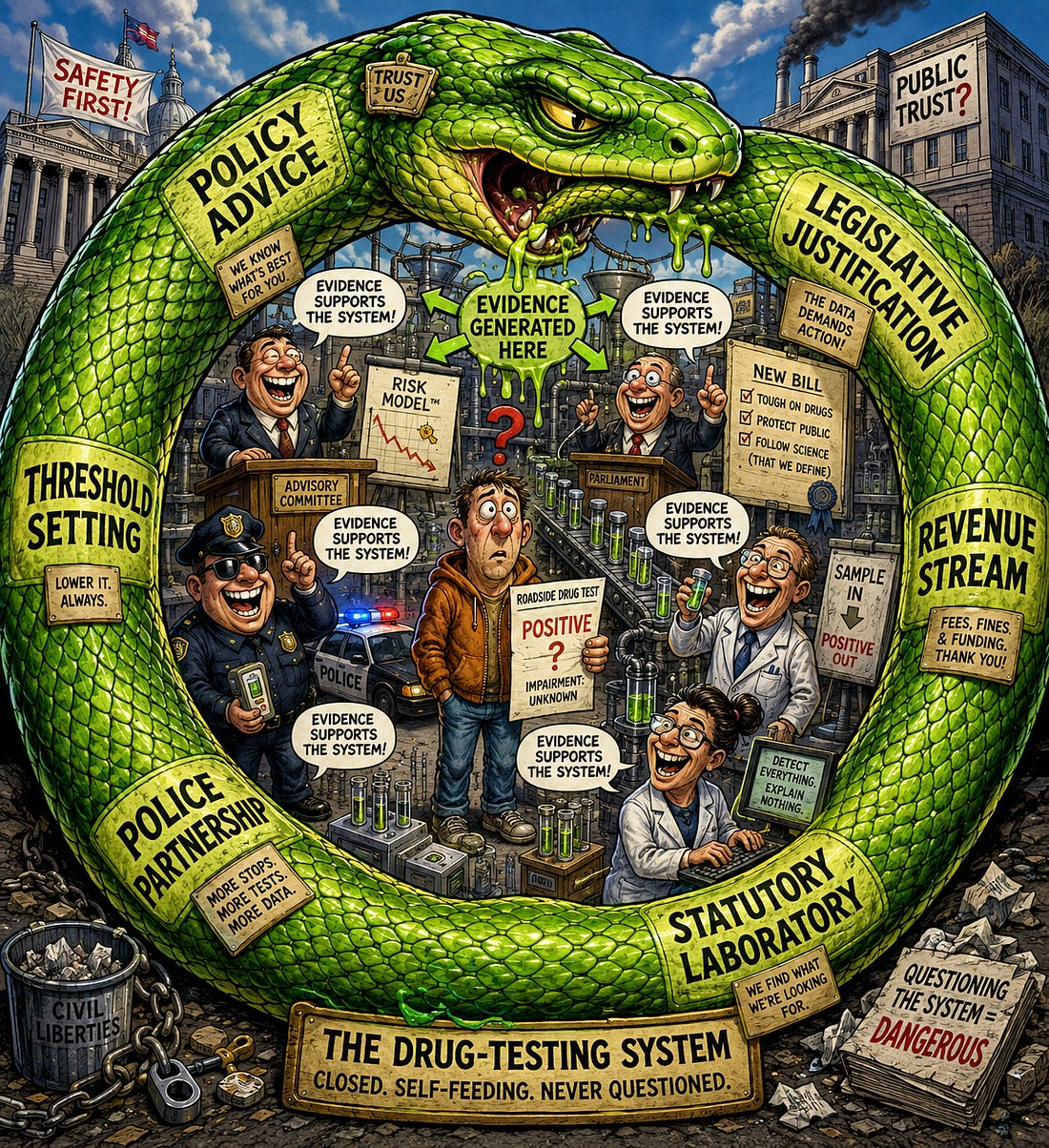
The Closed System
Put together, the structure looks like this:
PHF Science advises on policy
↓
PHF Science helps design thresholds
↓
PHF Science co‑develops Police drug‑detection technology
↓
PHF Science becomes the statutory laboratory
↓
PHF Science earns millions from testing
↓
PHF Science produces the data used to justify future policy
↓
PHF Science’s own toxicologist publicly defends the regime
This is not independence.
This is not separation.
This is not external oversight.
It is a closed loop — scientific, operational, financial, and legislative — all inside a single Crown‑owned forensic institution.
And the public has never been shown the structure.
Until now.
PART TWO — THE LOOP SYSTEM: How Government Programmes Become Self‑Feeding Machines
By Nigel Gray 23 AUGUST 2026
 |
The drug‑testing investigation revealed something far larger than a single flawed system.
It revealed a pattern.
A structural behaviour repeated across multiple government programmes — regardless of the domain, the agency, or the political party in power.
It is the pattern of the closed loop.
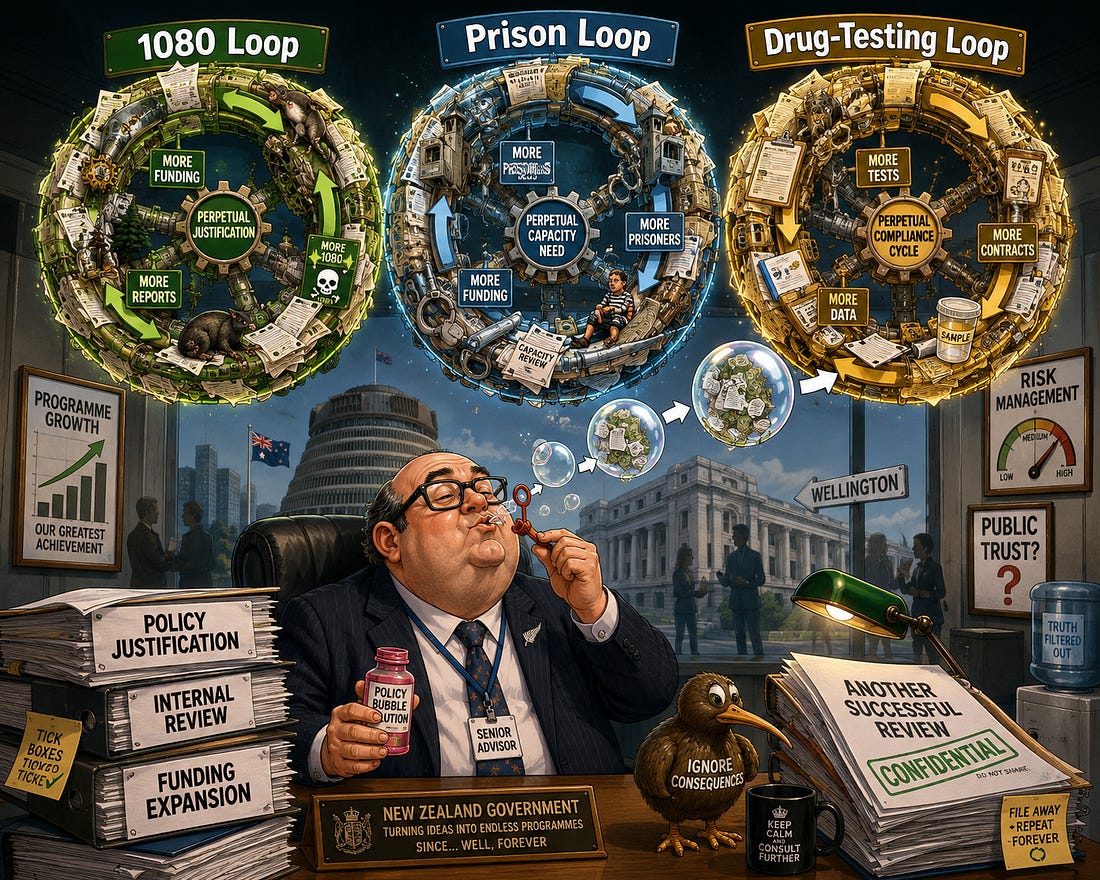
A loop is created when a government agency or Crown‑controlled organisation:
defines the problem,
designs the policy response,
implements the response,
enforces the response,
evaluates its own performance,
profits from the continuation of the programme,
and uses its own data to justify expanding the programme.
This is not independent oversight.
This is not accountability.
This is not separation of powers.
It is a self‑feeding machine.
And New Zealand has several of them.
1. The 1080 Loop
A Crown‑owned company manufactures 1080.
Government policy mandates its use.
Government agencies drop it.
Government protocols prevent detection of 1080 wildlife deaths.
Government narratives justify more 1080.
Government receives the profits.
The same system that creates the problem is the system that benefits from the solution.
A closed loop.
2. The Prison System Loop
Corrections defines the “risk”.
Corrections designs the rehabilitation programmes.
Corrections delivers the programmes.
Corrections evaluates its own success.
Corrections uses its own data to justify more funding.
Corrections expands the same programmes.
The same agency responsible for the problem is responsible for proving it solved the problem.
A closed loop.
3. The Drug‑Testing Loop (from Part One)
PHF Science (formerly ESR) helped design the drug‑driving regime.
PHF Science advised on thresholds.
PHF Science co‑developed Police drug‑detection technology.
PHF Science is the statutory laboratory.
PHF Science performs the evidential testing.
PHF Science earns millions from the programme.
PHF Science produces the data used to justify future legislative changes.
The same organisation that designs the system profits from the system and evaluates the system.
A closed loop.
The Pattern Is Now Clear
Across these domains, the same structural DNA appears:
The agency benefits from the continuation of the programme it is responsible for evaluating.
This is not how independent public systems are supposed to function.
This is how self‑reinforcing machines operate.
And once you see the pattern, you cannot unsee it.
Why This Matters
Closed loops create:
perverse incentives
policy blind spots
scientific conflicts
financial dependencies
circular justifications
unchallenged narratives
unexamined assumptions
unaccountable systems
They also create institutional momentum — programmes that continue not because they work, but because the system is built to perpetuate itself.
The drug‑testing loop is simply the most recent example.
It will not be the last.
PART THREE — THE FENZ LOOP: When Volunteers Fundraise and Bureaucrats Prosper
PART THREE — THE FENZ LOOP: When Volunteers Fundraise and Bureaucrats Prosper BY NIGEL GRAY INDEPENDENT INVESTIGATOR 23 AUGUST 2026
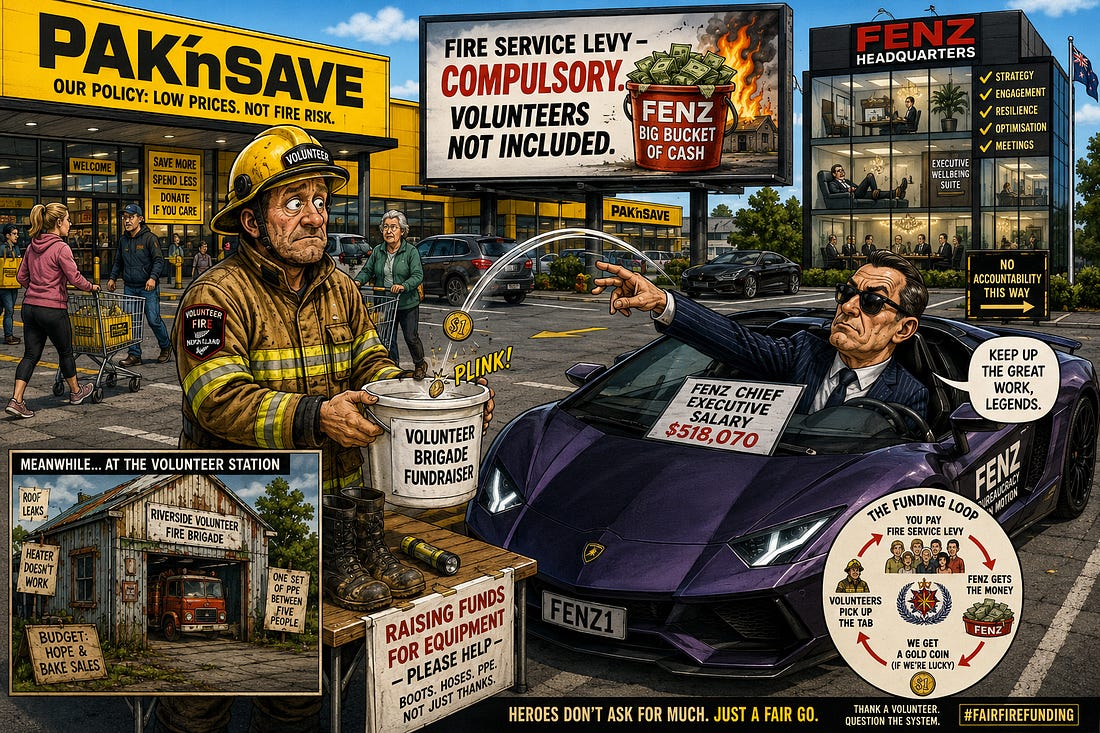
New Zealanders trust their firefighters. Because most of New Zealand’s firefighters are volunteers. They are unpaid. Meanwhile, Fire and Emergency New Zealand (FENZ) receives hundreds of millions of dollars through a compulsory levy charged on insurance policies. A levy that does not go to the volunteers. This is the FENZ Loop — the fourth major loop in New Zealand’s public‑sector machinery. 🧯 The Volunteer Reality Every New Zealander Already KnowsApproximately 85% of frontline firefighters in New Zealand are volunteers. They: respond to fires attend crashes rescue people train weekly maintain equipment leave work mid‑day get out of bed at 3am protect rural communities save lives And they do it for free. Volunteers: run raffles stand outside supermarkets fundraise for hoses, radios, and safety gear operate out of aging rural stations rely on community donations sometimes buy their own equipment This is not a rumour. And it raises the question the public already asks: If firefighters are volunteers… where does the money go? 🚗 The Satirical Reality That Makes the Loop VisibleImagine the scene: A volunteer firefighter stands outside Pak’nSave with a white donation bucket labelled “Volunteer Brigade Fundraiser.” A Lamborghini pulls up — glossy, exaggerated, cartoonishly luxurious. The driver is a sharply dressed bureaucratic figure labelled: He flicks a single $1 coin into the bucket. The firefighter thanks him. It’s satire. Because the imbalance is real. 💰 Where the Levy Money Actually GoesHere is the forensic breakdown — the part the public doesn’t see. 1. Centralised BureaucracyLevy revenue funds: national headquarters regional management layers administrative salaries HR, legal, communications internal review units consultants programme managers This is the bureaucratic expansion loop. 2. Capital Projects and Property PortfolioThe levy funds: station rebuilds new headquarters land acquisitions fleet upgrades IT infrastructure digital transformation projects The Auditor‑General has repeatedly flagged: cost overruns weak project controls poor asset management This is the capital‑expansion loop. 3. Internal Programmes and “Strategic Initiatives”The levy funds: resilience programmes cultural transformation diversity and inclusion initiatives organisational development capability uplift projects These programmes: expand annually justify themselves internally consume levy revenue This is the programme‑growth loop. 4. Executive Salaries and Management LayersThe levy funds: executives senior managers corporate leadership Volunteers do not receive salaries. This is the hierarchy‑funding loop. 5. Procurement and ContractsThe levy funds: procurement processes external contracts consultants outsourced services The Auditor‑General has raised concerns about: procurement discipline contract management value for money This is the procurement loop. 🔄 The FENZ Loop in One SentenceA compulsory levy funds a centralised bureaucracy, while the frontline workforce is mostly unpaid volunteers who must fundraise for their own equipment. That is the loop. 🧬 Why This Loop Matches the OthersFENZ shares the same structural DNA as: the 1080 loop the prison loop the drug‑testing loop All four systems follow the same pattern: 1. A Crown entity defines the problem2. The same entity designs the solution3. The same entity implements the solution4. The same entity evaluates the solution5. The same entity receives guaranteed funding6. The same entity uses its own data to justify expansionThis is loop governance. And FENZ is one of the clearest examples. 📣 Why This Article Will Get NoticedBecause the imbalance is visible. New Zealanders may not understand: levy mechanics Crown‑entity governance Auditor‑General reports procurement frameworks But they do understand: the volunteer firefighter outside Pak’nSave the donation bucket the raffle tickets the sausage sizzles the underfunded rural station the community fundraising for gear When people realise that the levy doesn’t go to them, the loop becomes undeniable. This is the emotional and political entry point. |