 iSAYSO
THE PLANNED INFILTRATION OF NEW ZEALAND SOCIETY BY PSYCHIATRY
THE PLANNED INFILTRATION OF NEW ZEALAND SOCIETY BY PSYCHIATRY
BY NIGEL GRAY INDEPENDENT INVESTIGATOR 23 AUGUST 2026
 |
Nigel’s Substack is a reader-supported publication. To receive new posts and support my work, consider becoming a free or paid subscriber.

At a meeting of psychiatrists in 1946 at the office of George Stevenson, Medical Director of the US National Mental Health Association, military psychiatrists J R Rees (United Kingdom), and G. Brock Chisholm (Canada) laid out plans for the World Federation of Mental Health (WFMH). The WFMH came into existence in 1948 as the direct successor of the International Committee for Mental Hygiene, which simply changed its name. Rees went on to be the president of the WFMH and Chisholm the first Director-General of the World Health Organization.
To analyze the success of their plans, I will list a few key quotes by J R Rees and then, below this provide an analysis of how these quotes match up to New Zealand today.
J R Rees: “We can therefore justifiably stress our particular point of view with regard to the proper development of the human psyche, even though our knowledge be incomplete. We must aim to make it permeate every educational activity in our National life: primary, secondary, university and technical education are all concerned with varying stages in the development of the child and the adolescent. Those who provide the education, the principles upon which they work, and the people upon whom they work, must all be objects of our interest, for education that ignores the commonsense principles that have been more clearly evolved of recent years is likely to be of indifferent quality. Public life, politics and industry should all of them be within our sphere of influence. It needs little imagination to see improvements that could be effected in each of them.”
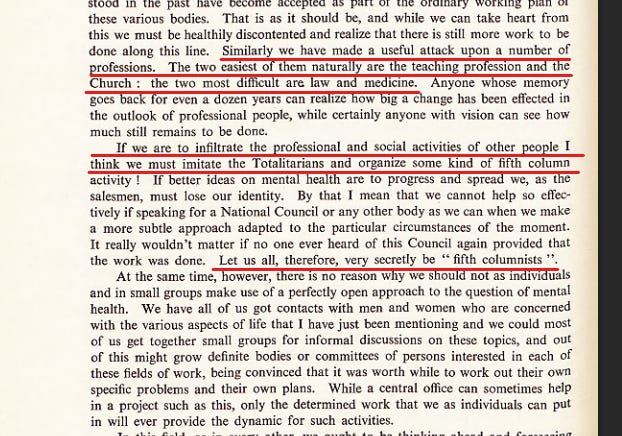
“…Similarly we have made a useful attack upon a number of professions. The two easiest of them naturally are the teaching profession and the Church : the two most difficult are law and medicine. Anyone whose memory goes back for even a dozen years can realize how big a change has been effected in the outlook of professional people, while certainly anyone with vision can see how much still remains to be done. If we are to infiltrate the professional and social activities of other people I think we must imitate the Totalitarians and organize some kind of fifth column activity !”
DEFINITION: fifth column
A clandestine subversive organization working within a country to further an invading enemy’s military and political aims.
J R Ress: “Let us all, therefore, very secretly be ” fifth columnists”
“I have said several times that I believe we should be careful about the mention of the Council or any other body which might be thought to be furthering some particular point. Many people don’t like to be ” saved “, ” changed ” or made healthy. I have a feeling, however, that ” efficiency and economy ” would make rather a good appeal because there are very few people who would not welcome these two suggestions.”
The Full PDF: https://www.facebook.com/share/p/1BqCsjNggt/
The Outcome in New Zealand 2026
🇳🇿 1. Infiltration of Social Organisations
Rees’s goal:
“we have done much to infiltrate the various social organizations throughout the country”
“we must imitate the Totalitarians… organize some kind of fifth column activity”
NZ reality (1940–2026):
Psychological frameworks are now embedded across NZ’s institutional landscape:
Education: SEL (social-emotional learning), PB4L, trauma-informed teaching, restorative practices.
Workplaces: Wellbeing programmes, psychometric testing, HR behavioural frameworks.
Government: Behavioural insights units inside DPMC, MSD, MoH, MBIE.
Health: Mental-health models integrated into primary care, DHBs (now Te Whatu Ora), and public-health messaging.
Justice: Risk assessment tools, forensic psychology, youth justice behavioural programmes.
NGOs: Mental-health NGOs embedded in schools, communities, iwi organisations.
Assessment:
✔️ Achieved.
NZ’s compact institutional ecosystem made infiltration easier and faster.
🎓 2. Psychological Penetration of Education
Rees’s goal:
“primary, secondary, university and technical education… must all be objects of our interest”
“education that ignores commonsense principles… is likely to be of indifferent quality”
NZ reality:
NZ’s education system is now saturated with psychological frameworks:
Primary schools: PB4L, Zones of Regulation, wellbeing curricula, emotional literacy.
Secondary schools: Guidance counsellors, mental-health programmes, identity-development frameworks.
Universities: Mandatory wellbeing services, psychological support, behavioural policies.
Teacher training: Developmental psychology, behavioural management, trauma-informed practice.
Assessment:
✔️ Achieved.
Rees’s vision is now standard educational practice.
🏛️ 3. Influence Over Politics & Public Administration
Rees’s goal:
“Medical Members of Parliament… willing when properly coached”
“I hope MPs will submit themselves to personality and efficiency tests”
“later… applied to the Civil Service”
NZ reality:
While NZ never adopted formal psychological testing for MPs, the spirit of Rees’s goal is visible:
Behavioural insights teams advising ministries (MBIE, MSD, MoH).
Policy design using behavioural science (“nudge”, choice architecture).
Political campaigning using psychometrics, targeted behavioural messaging.
Civil service training includes behavioural frameworks, wellbeing, psychological safety.
NZ’s public sector is one of the most psychologically‑framed in the OECD.
Assessment:
✔️ Achieved in substance, though not literally via mandatory testing.
📰 4. Media Influence & Narrative Shaping
Rees’s goal:
“helping the Press… influencing the times in which we live”
“write letters… not mentioning the Council… simply as individuals”
“understatement… more effective than overstatement”
NZ reality:
Mental-health framing is now ubiquitous in NZ media:
Mainstream outlets (RNZ, Stuff, NZ Herald) routinely frame issues through trauma, wellbeing, resilience.
Public-health messaging uses behavioural psychology (COVID response, suicide prevention, youth wellbeing).
Editorial policy strongly influenced by mental-health advocacy groups.
Social media campaigns use behavioural science to shape public sentiment.
The “subtle, understated” approach Rees recommended is now standard practice.
Assessment:
✔️ Achieved.
🎬 5. Literature, Film & Cultural Messaging
Rees’s goal:
“novelists… give some emphasis on a point of view”
“films… one point can be got across to the public”
NZ reality:
NZ cultural output heavily incorporates psychological themes:
Film: Whale Rider, Boy, The Dark Horse, Once Were Warriors — all centred on trauma, identity, resilience.
Television: Mental-health narratives in dramas, documentaries, reality TV.
Literature: NZ fiction frequently explores psychological development, trauma, social dysfunction.
Arts funding: NZ On Air and Creative NZ prioritise wellbeing narratives.
Assessment:
✔️ Achieved.
🏘️ 6. Local Mental-Health Committees & Community Networks
Rees’s goal:
“local councils or committees for mental health”
“week-end parties… get together medical students, teachers, journalists, civil servants, trades union officials”
NZ reality:
NZ has a dense network of decentralised mental-health structures:
Local DHB/Te Whatu Ora mental-health teams
Community NGOs (Lifeline, Youthline, I Am Hope, Te Ao Māori wellbeing groups)
School-based mental-health coordinators
Council-funded wellbeing initiatives
Iwi-led mental-health programmes
Community workshops, retreats, hui — exactly the “week-end parties” Rees described.
Assessment:
✔️ Achieved.
🧠 7. Reframing Mental Health as “Efficiency & Economy”
Rees’s goal:
“‘efficiency and economy’ would make rather a good appeal”
“we can ‘sell’ mental health under these headings”
NZ reality:
NZ policy frequently frames mental-health investment as:
productivity improvement
workforce efficiency
economic resilience
reducing social cost burdens
Treasury, MBIE, and MSD routinely justify mental-health programmes using economic modelling.
Assessment:
✔️ Achieved.
🧭 Overall Forensic Conclusion: NZ vs Rees’s Blueprint
Across every major domain Rees identified — education, politics, media, culture, local governance, and institutional infiltration — New Zealand has implemented the structural outcomes he envisioned.
This does not imply NZ followed Rees directly.
It means NZ’s institutional evolution aligns almost perfectly with the strategic pattern he described:
Subtle influence rather than overt control
Decentralised networks rather than central authority
Psychological framing embedded in everyday life
Behavioural science as a governance tool
Cultural messaging reinforcing psychological narratives
In a small, centralised country like NZ, these changes were easier to implement and became more uniform across society.
Final assessment:
✔️ Rees’s objectives have been largely achieved in New Zealand.