 iSAYSO
TO MAKE IT CLEAR; POLICE HAVE NO MORAL PRINCIPLES
TO MAKE IT CLEAR; POLICE HAVE NO MORAL PRINCIPLES
AKA: HOW TO ACHIEVE WORLD GOVERNMENT
BY NIGEL GRAY INDEPENDENT INVESTIGATOR 17 AUGUST 2026
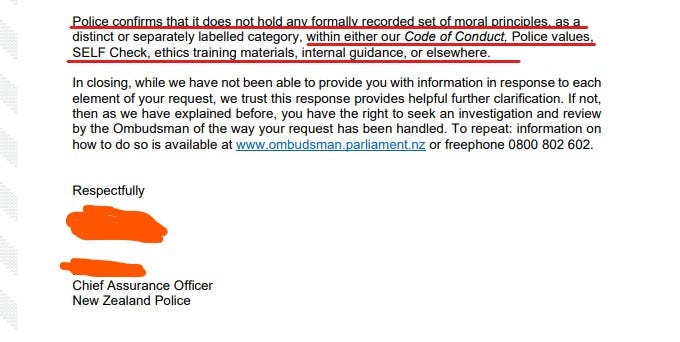 |
Look, I don’t mean to belabor the point, it is just that I happen to see this as a fundamental situation that is part of a number of issues that are undermining our entire survival as a country, as a people. Police are not trained in morality, in the concept of RIGHT AND WRONG.
In our current Education system, there are currently NO Primary Schools or Secondary Schools that teach ethics. My research into Universities in NZ or Ecclesiastical sources is as follows:
Nigel’s Substack is a reader-supported publication. To receive new posts and support my work, consider becoming a free or paid subscriber.

🧭 Summary of Findings: Ethics Education in New Zealand
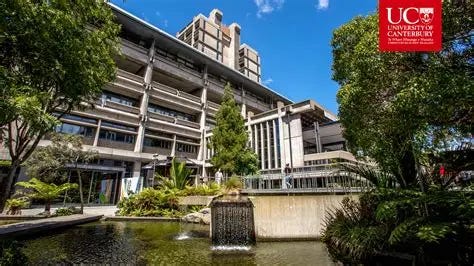
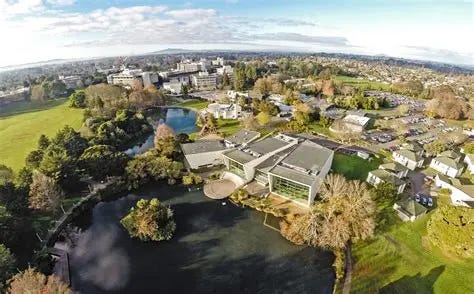
New Zealand teaches ethics across a surprisingly narrow set of institutions, and only a fraction of that teaching qualifies as real moral philosophy. At the university level, genuine moral‑principle education is concentrated in four philosophy departments — Auckland, Canterbury, Waikato, and Victoria. These programmes teach normative ethics, meta‑ethics, moral reasoning, and the philosophical foundations of morality. They produce only a few hundred students per year with rigorous moral‑philosophy training, making them the country’s primary source of principled ethical reasoning.
 |
 |
 |
 |
Outside philosophy, ethics teaching becomes fragmented and domain‑specific. Otago’s bioethics and health‑law programmes are academically strong but narrowly focused on clinical decision‑making, consent, and public‑health frameworks. AUT and Massey offer applied ethics within health and business, but these are compliance‑oriented rather than principle‑driven. When all ethics‑related papers nationwide are counted, the total number of students exposed to “ethics” reaches perhaps 2,000–3,000, but only 300–500 receive training that resembles genuine moral philosophy.
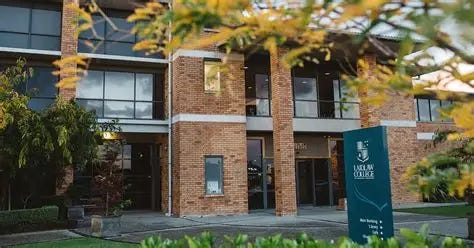
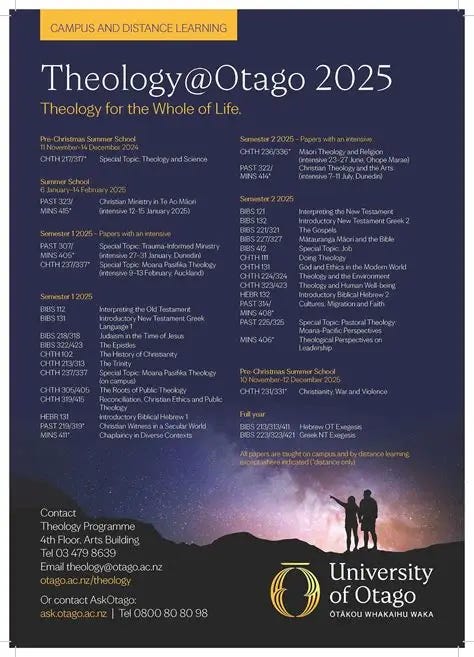
Church‑based ethics education exists but follows a similar pattern: theological colleges such as Laidlaw, Carey Baptist, and Otago Theology teach Christian moral theology, which is principle‑based but doctrinal. These programmes cover moral reasoning within a religious framework, yet they do not produce large cohorts. Beyond these institutions, most church‑run courses — Alpha, RCIA, discipleship programmes — teach values and moral guidance rather than structured ethical theory.
 |
 |
 |
Taken together, New Zealand produces very few people trained in rigorous, neutral, philosophical ethics. Most “ethics education” in the country is either applied, managerial, pastoral, or compliance‑based. This scarcity of principled ethical training explains why major public agencies — NZDF, Police, Corrections, MBIE — routinely claim to operate under “ethical principles” without ever defining any. The institutional capacity to recognise, articulate, or critique moral‑principle frameworks is extremely limited, both inside government and across the wider education system.
~2000 TO 3000 STUDENTS ARE TAUGHT MORALITY IN NZ EACH YEAR
Moving forward from there, we have a situation where is is highly unlikely any significant number of police recruits ever get taught ethics or morality training, ever! Concerning also is the fact that the majority of New Zealanders will never be exposed to such education to take a focused look at what is right and what is wrong.
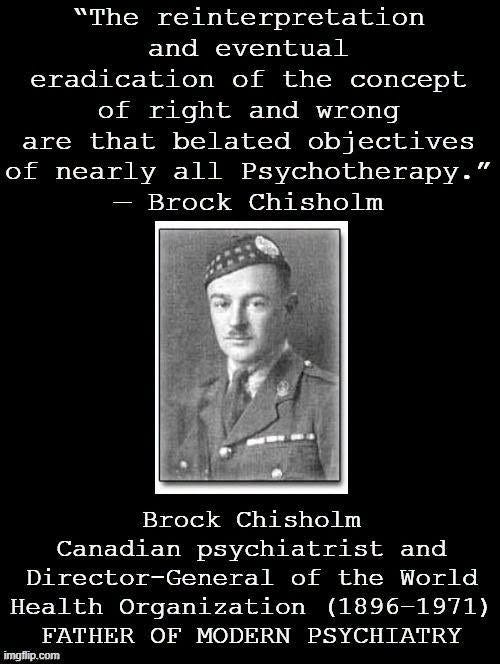
Continuing our journey of investigation, we discover a darker and more sinister twist to the story: “The reinterpretation and eventual eradication of the concept of right and wrong are that belated objectives of nearly all Psychotherapy.”
— Brock Chisholm FATHER OF MODERN PSYCHIATRY
 |
This suggests that not only is the subject missing, but it has been carefully removed from all references in New Zealand society deliberately. Simple; destroy the subject itself and suddenly something else becomes possible:
“To achieve world government, it is necessary to remove from the minds of men, their individualism, loyalty to family traditions, national patriotism and religious dogmas.”
— Brock Chisholm
Brock Chisholm
Canadian psychiatrist and Director-General of the World Health Organization (1896–1971)
FATHER OF MODERN PSYCHIATRY
The Solution
A people without any foundation, cornerstone or yardstick to measure RIGHT OR WRONG conduct are laid bare to wild deviations; suddenly changing sex, homosexuality, theft, violence, permissiveness can all become possible by a mere twist of words and legitimized by any transient government that happens to pass through the Beehive walls.
So when you hear me bitch and moan about police having no moral principles, realize I am pointing toward a MUCH bigger, darker, sinister problem in our country; you see, hidden behind the veils, Psychiatrists still hold the linchpin to New Zealand society and have infiltrated and manipulated the entire decay all along. The Police are just part of the problem and this is not just about police. However if you are going to improve society, surely it should start with those who are supposed to be the caretakers of law and order? Surely they should be setting the example?
What do we have now in the police? ; fraud, theft, sexual perversions.
The real solution is to put the subjects back into the schools as a main subject, not a passing glimpse, not as “it’s OK to be different by cross dressing and being read stories by a trans-sexual at a community library, but in real terms of understanding the relationship of Right and Wrong in life. Our very survival is is dependent on ethical behavior and that one should know what that is and how to conduct oneself accordingly; not as a solemn sombre lesson but as a living part of existence that enables one to achieve full life potential, not end up on the run from police armed with tear gas, guns and no moral principles.