 iSAYSO
The Missing Instruction: How Health NZ Left a Critical Clinical Duty Undefined
The Missing Instruction: How Health NZ Left a Critical Clinical Duty Undefined
By Nigel Gray — Independent Investigator
12 August 2026
Introduction: A System That Admits the Problem but Has No Response
 |
Nigel’s Substack is a reader-supported publication. To receive new posts and support my work, consider becoming a free or paid subscriber.

Every New Zealander who takes long‑term medication is part of an unspoken national experiment.
We prescribe medications that are known — in pharmacology literature, Medsafe data sheets, and international clinical guidelines — to deplete essential nutrients. These nutrients are not optional. They are required for neurological function, cardiovascular stability, immune resilience, metabolic regulation, and basic physiological recovery.
Metformin depletes B12.
Proton pump inhibitors deplete magnesium.
Statins deplete CoQ10.
Diuretics deplete potassium and magnesium.
Anticonvulsants deplete vitamin D.
Oral contraceptives deplete folate, B6, and magnesium.
These are not controversial claims. They are well‑established biochemical effects.
And yet, when asked directly whether Health NZ has ever issued any communication at all instructing clinicians to:
inform patients about nutrient depletion caused by medications, and
provide or recommend the vitamins and minerals required to correct that depletion,
Health NZ cannot identify a single policy, guideline, directive, or training module.
Not one.
This is not a documentation gap.
It is not a training oversight.
It is not a missing memo.
It is a national governance failure.
The OIA That Exposed the Silence
On 5 August 2026, I filed an Official Information Act request asking Health NZ to provide documents showing how the health system ensures treatment is complete when medications deplete essential nutrients.
Health NZ responded by acknowledging:
“Medicines can have a range of adverse effects, including the depletion of essential nutrients.”
And:
“Information on how these impacts are identified and managed is not consolidated within a single policy or procedure.”
This is an extraordinary admission.
It means:
Health NZ knows nutrient depletion occurs.
Health NZ knows it affects patient recovery.
Health NZ knows it is relevant to treatment.
Health NZ knows it has no consolidated system to manage it.
So I refined the request to the simplest possible form:
Provide any communication instructing clinicians to inform patients about nutrient depletion caused by medications and to provide the nutrients required to correct that depletion. If none exist, state this explicitly.
This is the most basic question a health system can be asked.
It is not about specific medications.
It is not about specific hospitals.
It is not about specific illnesses.
It is about whether the health system has ever told clinicians to complete treatment.
Why This Matters: Treatment Without Completion Is Not Treatment
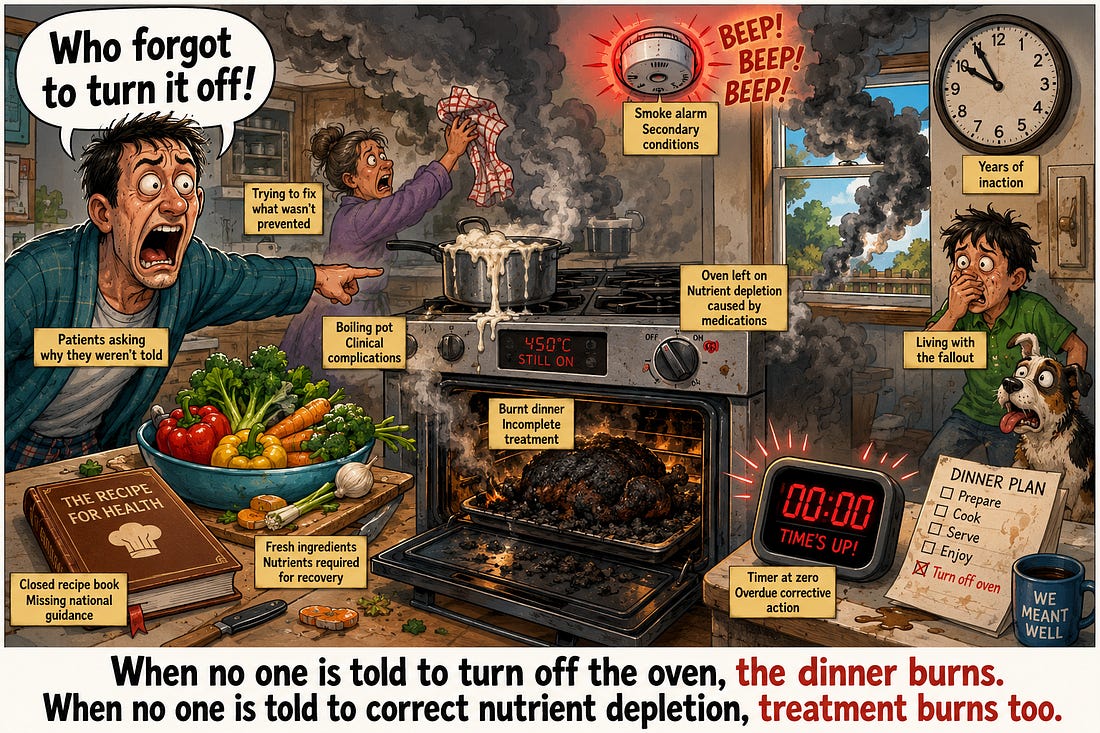
When a medication depletes a nutrient required for recovery, and the health system provides no instruction to correct that depletion, then treatment is left incomplete by design.
Incomplete treatment has consequences:
fatigue
neuropathy
muscle weakness
cognitive decline
immune suppression
cardiovascular instability
preventable secondary conditions
increased hospitalisation risk
increased long‑term care burden
increased pharmaceutical dependency
These are not hypothetical harms.
They are predictable biochemical outcomes.
If a health system knowingly prescribes medications that create nutrient deficiencies — while providing no mechanism to ensure those deficiencies are corrected — then the system is not maintaining health.
It is manufacturing secondary conditions.
The Governance Vacuum
Health NZ’s own admission reveals the vacuum:
No national policy
No district policy
No hospital policy
No clinical guideline
No training module
No directive
No memo
No instruction
No monitoring requirement
No rehabilitation pathway
No harm‑minimisation framework
The absence is total.
This is not a failure of execution.
It is a failure of design.
A health system cannot claim to “diagnose and treat disease or injury and maintain health” — the statutory definition of medicine — if it does not ensure treatment is complete.
Medication‑induced nutrient depletion is a treatment‑relevant harm.
Correcting that depletion is part of treatment.
Failing to correct it leaves treatment incomplete.
And yet, Health NZ has never issued a single instruction requiring clinicians to address it.
The Consequences for Patients
Every patient on long‑term medication is affected.
Every GP who prescribes these medications is affected.
Every hospital that treats chronic conditions is affected.
Every district that manages long‑term care is affected.
The absence of guidance means:
patients are not informed
clinicians are not instructed
nutrient depletion is not monitored
secondary conditions are not prevented
treatment is not completed
health is not maintained
This is not a theoretical governance failure.
It is a lived one.
The Consequences for the Health System
The absence of instruction creates systemic distortions:
Unfunded secondary conditions
Patients develop conditions caused by medications, but the system has no funding pathway to address them.
Misclassified harms
Nutrient depletion is not classified as a treatment‑relevant harm, so it is invisible in reporting.
Distorted cost modelling
Medication costs are funded; nutrient restoration is not.
Fragmented clinical practice
Some clinicians know about nutrient depletion; others do not.
Inconsistent patient outcomes
Recovery varies based on whether a clinician independently knows to correct depletion.
Increased long‑term burden
Preventable complications become chronic conditions.
This is not a small gap.
It is a structural flaw.
Why the Refined OIA Matters
The refined OIA forces Health NZ to answer a single binary question:
Has Health NZ ever told clinicians to correct nutrient depletion caused by medications?
If the answer is yes, they must produce the documents.
If the answer is no, they must admit that:
treatment is left incomplete
harm is unaddressed
monitoring is absent
rehabilitation is absent
prevention is absent
funding is misaligned
health maintenance is not operationalised
the statutory definition of medicine is not fulfilled
This is the core governance failure.
What Happens Next
If Health NZ confirms that no communication exists, then:
Parliament must ask why.
Medsafe must ask why.
Pharmac must ask why.
The Health Minister must ask why.
Clinicians must ask why.
Patients must ask why.
Because a health system that does not ensure treatment is complete is not maintaining health.
It is manufacturing preventable harm.
Conclusion: The Silence Is the System
The absence of instruction is not an accident.
It is the architecture.
The refined OIA request exposes the truth:
New Zealand has a health system that recognises medication‑induced nutrient depletion but has never instructed clinicians to address it.
This is the governance failure at the centre of the system.
And now that the silence has been exposed, it cannot be ignored.
Nigel’s Substack is a reader-supported publication. To receive new posts and support my work, consider becoming a free or paid subscriber.