 iSAYSO
Structured Investigative Roadmap: New Zealand’s Gold Reserve Policy, Foreign Extraction Regime & Governance‑Risk Factors
Structured Investigative Roadmap: New Zealand’s Gold Reserve Policy, Foreign Extraction Regime & Governance‑Risk Factors
By Nigel Gray 9 August 2026
 |
This roadmap outlines the method I will use to investigate New Zealand’s decision to hold zero gold reserves, its permissive foreign‑extraction regime, and the governance vulnerabilities that arise when strategic resources are treated purely as commodities.
It is published publicly to ensure transparency, accountability, and a clear audit trail of the investigative process.
1. Establish the Factual Baseline
New Zealand officially holds no gold reserves.
The Reserve Bank of New Zealand (RBNZ) divested its gold in the early 1990s and has maintained a zero‑gold position ever since, despite a global trend of central banks increasing gold holdings for strategic stability.
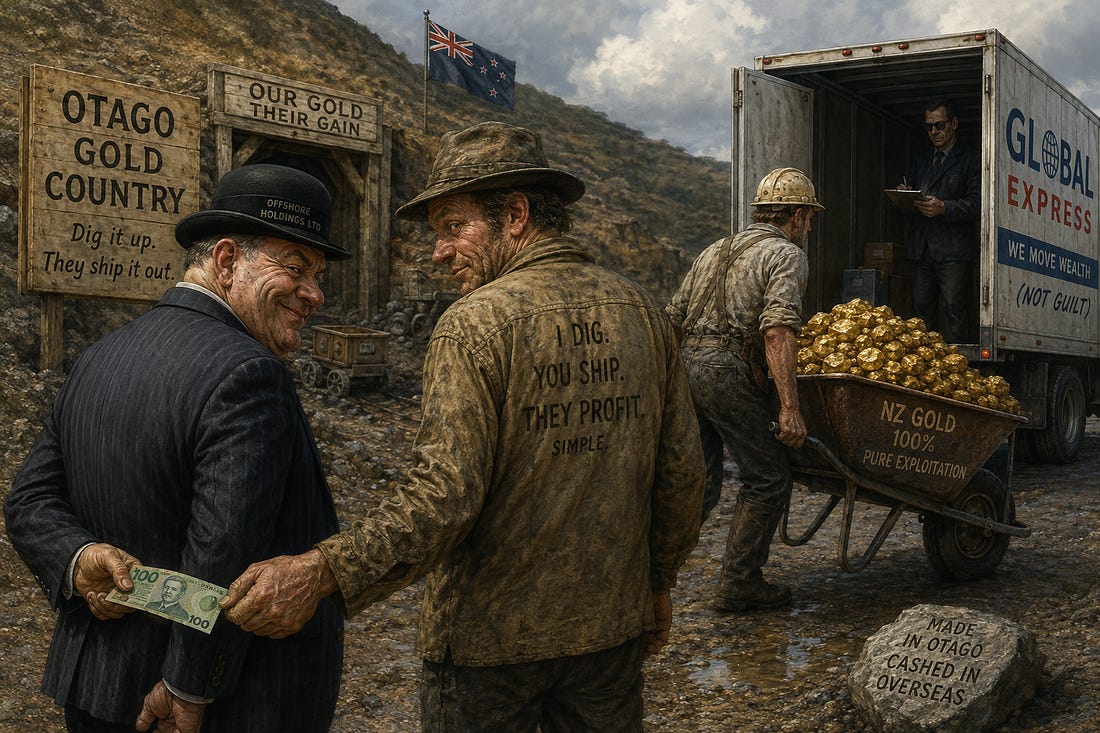
Simultaneously, New Zealand continues to expand gold extraction through foreign‑owned mining operations. These companies export gold offshore under low royalty regimes, while NZ retains none of the strategic asset.
This contradiction forms the foundation of the investigation.
Key follow‑ups:
RBNZ gold reserve policy
NZ gold extraction royalty structure
2. Identify the Governance Vulnerabilities
The investigation focuses on systemic failures, not allegations of criminal wrongdoing.
Key vulnerabilities include:
Reserve Bank mandate conflict — RBNZ must maintain financial stability yet holds no gold despite global reserve diversification.
Minimal royalty extraction regime — foreign miners pay around 1% of extracted value while exporting all gold offshore.
Absence of contemporary modelling — RBNZ has no modern analysis of gold’s strategic role, global accumulation trends, or NZD exposure.
Fast‑tracked mining approvals — extraction is accelerated without any parallel reserve strategy.
No sovereign gold retention mechanism — NZ has no policy to retain even a fraction of domestically extracted gold.
Key follow‑ups:
Reserve Bank mandate analysis
Strategic asset governance
3. Build the Evidentiary Chain
The investigation will assemble a chain of facts demonstrating systemic contradiction:
NZ holds zero gold reserves.
Foreign companies extract NZ gold under minimal royalty.
NZ has no modelling of global gold accumulation impacts.
Government accelerates extraction.
Other central banks accumulate gold at record pace.
IMF warns domestic gold purchase programs require safeguards.
NZ has no such safeguards because it has no program at all.
This chain exposes a governance failure, not a conspiracy.
Key follow‑ups:
Global central bank gold accumulation
IMF guidance on gold reserve governance
4. Use OIAs to Force Contradictions Into Daylight
Targeted Official Information Act requests will expose gaps in modelling, policy, and risk assessment.
Key OIAs include:
Modelling of global gold accumulation trends
Analysis of NZ’s royalty regime vs strategic reserve needs
Cabinet briefings on gold as a strategic asset
Risk assessments on foreign‑owned gold extraction
RBNZ justification for maintaining zero gold reserves
These OIAs are designed to force agencies to acknowledge what they should have done but didn’t.
Key follow‑ups:
Request RBNZ modelling of NZD volatility under declining USD dominance
Request analysis comparing gold vs foreign currency reserves
Request RBNZ assessment of BRICS gold settlement systems
5. Demonstrate the Economic Absurdity
The investigation will model the long‑term financial impact of NZ’s zero‑gold policy.
For example:
If NZ had dollar‑cost averaged NZ$1B/year in gold since 1992, the reserve would now be worth tens of billions.
This simple modelling highlights:
lost strategic value
lost sovereign resilience
lost diversification
lost opportunity
systemic negligence in reserve management
Key follow‑up:
Model NZ’s hypothetical gold reserve growth
6. Frame the Issue as a Sovereignty Failure
The investigation will present the findings as a sovereignty and governance failure, not a criminal allegation.
The core contradiction:
NZ treats gold as a commodity.
Foreign companies treat NZ gold as profit.
Other governments treat gold as a strategic reserve asset.
NZ holds none.
RBNZ has no modelling.
Government accelerates extraction.
This is a governance failure.
Key follow‑up:
Explain sovereignty implications of zero gold reserves
7. Governance‑Risk Assessment (Including Improper Influence Safeguards)
Given the high economic value of gold extraction, the permissive royalty regime, and the absence of strategic reserve policy, the investigation will assess whether governance safeguards against improper influence, conflicts of interest, and procurement integrity failures are adequate.
This is a standard component of any resource‑sector investigation and does not imply wrongdoing by any individual or organisation.
This section will examine:
conflict‑of‑interest disclosures for officials involved in mining approvals
communications between mining companies and relevant ministries
procurement integrity audits for mining‑related decisions
Cabinet Office guidance on managing improper influence in resource extraction
Treasury’s risk assessment on foreign extraction incentives
Key follow‑ups:
Request conflict‑of‑interest disclosures for mining approvals
Request communications between mining companies and ministries
Request procurement integrity audits for mining decisions