New Zealand’s Extraction Economy and the Reserve Bank’s Admission: A Request for Explanation and Action
By Nigel Gray, Napier — 6 August 2026
Prime Minister,
Today, the Reserve Bank of New Zealand released an Official Information Act response that is, in my view, one of the most consequential admissions made by a New Zealand institution in recent memory.
In response to my request for:
analysis of global gold accumulation trends,
modelling of USD reserve decline,
risk assessments of BRICS commodity‑settled trade,
justification for New Zealand’s zero gold reserves,
and any internal debate about reviewing our reserve strategy,
the Reserve Bank stated:
“The Reserve Bank… has not done any assessments… The documents alleged to contain the requested information does not exist.”
This means that New Zealand’s central bank — the institution responsible for safeguarding national financial resilience — has never analysed the largest global reserve‑management shift since the 1960s.
This revelation is not an isolated oversight. It is the missing piece that explains a much larger pattern.
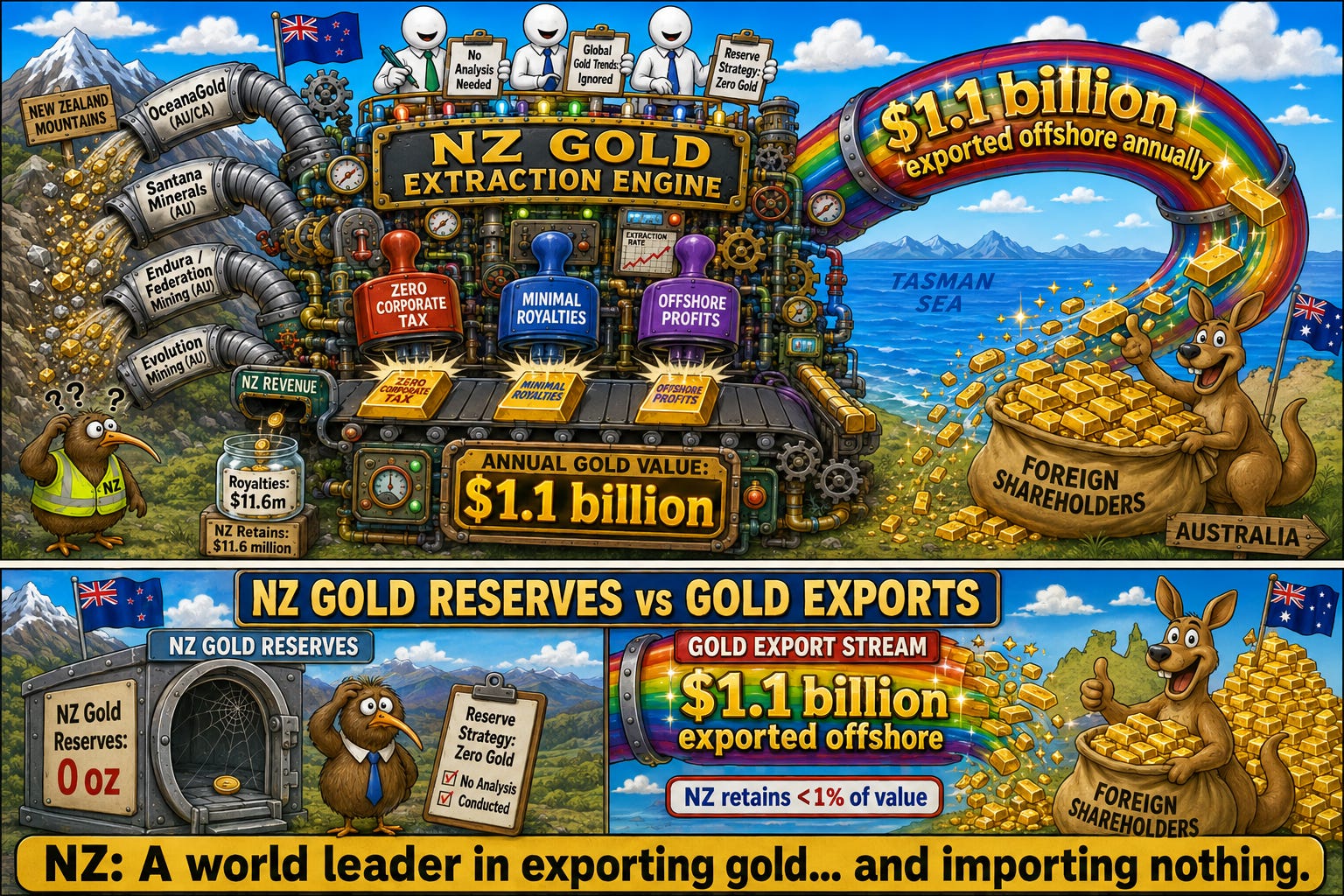
1. New Zealand exports $1.1 billion in gold annually — and retains less than 1%
New Zealand’s gold sector is now almost entirely foreign‑owned:
OceanaGold (AU/CA)
Santana Minerals (AU)
Endura/Federation Mining (AU)
Evolution Mining (AU)
These companies extract $1.1 billion in gold each year.
New Zealand retains:
Royalties: $11.6 million
Corporate tax: often zero
Strategic reserves: zero
Foreign shareholders retain:
the profit,
the export revenue,
the capital gains,
and the long‑term strategic value.
Meanwhile, New Zealand holds 0 ounces of gold in its national reserves.
And the Reserve Bank has never analysed whether this is strategically safe.
2. Foreign‑owned data centres drain NZ electricity while exporting profit
New Zealand has aggressively courted foreign hyperscale data centres:
Microsoft
Amazon
Google
Overseas private equity infrastructure funds
These facilities:
consume enormous electricity,
require massive cooling water,
pay minimal tax,
export profits offshore,
and create very few jobs relative to resource consumption.
New Zealand retains:
the grid strain,
the environmental cost,
and a fraction of the economic value.
Again, the Reserve Bank has never analysed the long‑term implications for national resilience.
3. Foreign‑owned prison models have extracted profit from NZ incarceration
New Zealand’s corrections system has been influenced by foreign operators and foreign management models.
The pattern is identical:
NZ carries the social cost,
foreign entities capture the financial benefit.
No strategic modelling has been done on the long‑term consequences of outsourcing core state functions.
4. Forestry, water, electricity, and infrastructure repeat the same pattern
Across multiple sectors:
raw logs,
bottled water,
electricity generation,
transmission infrastructure,
and strategic assets,
New Zealand retains:
environmental cost,
infrastructure burden,
and minimal fiscal return.
Foreign owners retain:
profit,
capital gains,
and strategic control.
This is not accidental. It is structural.
5. The Reserve Bank’s admission is the keystone
Prime Minister, the Reserve Bank’s statement reveals that:
New Zealand has no modelling of global reserve realignment,
no analysis of gold accumulation trends,
no assessment of USD decline scenarios,
no evaluation of commodity‑settled trade systems,
no justification for holding zero gold reserves,
and no strategic review of our reserve composition.
This is not simply a blind spot. It is a systemic vulnerability.
And it raises a direct question:
Prime Minister Luxon, why has this not been addressed?
Given the scale of foreign extraction across:
gold,
data centres,
prisons,
forestry,
water,
electricity,
and infrastructure,
and given the Reserve Bank’s admission of zero analysis of global reserve trends,
I respectfully request that you explain:
1. Why has the Government not required the Reserve Bank to analyse global gold accumulation trends?
2. Why has New Zealand maintained zero gold reserves despite exporting $1.1 billion in gold annually?
3. Why has no modelling been done on USD reserve decline or BRICS commodity‑settled trade systems?
4. Why has New Zealand not reviewed its reserve strategy in light of global changes?
5. What steps will your Government take to ensure New Zealand is not left strategically exposed?
6. Will you commit to commissioning an urgent, cross‑agency review of New Zealand’s reserve strategy and extraction‑economy vulnerabilities?
New Zealand deserves answers.
And New Zealand deserves a reserve strategy that is based on analysis, modelling, and foresight — not on assumptions, inertia, or external dependency.
 iSAYSO