 iSAYSO
Reserve Bank of New Zealand responded to an Official Information Act about Gold
New Zealand’s Extraction Economy: The Day the Reserve Bank Confirmed the Blind Spot
A DEVASTATING REVELATION OF RAPE, PILLAGE AND PLUNDER OF NZ’S ASSETS
New Zealand’s Extraction Economy: The Day the Reserve Bank Confirmed the Blind Spot
BY NIGEL GRAY 6 AUGUST 2026 PLEASE SHARE THE HELL OUT OF THIS!!!!!
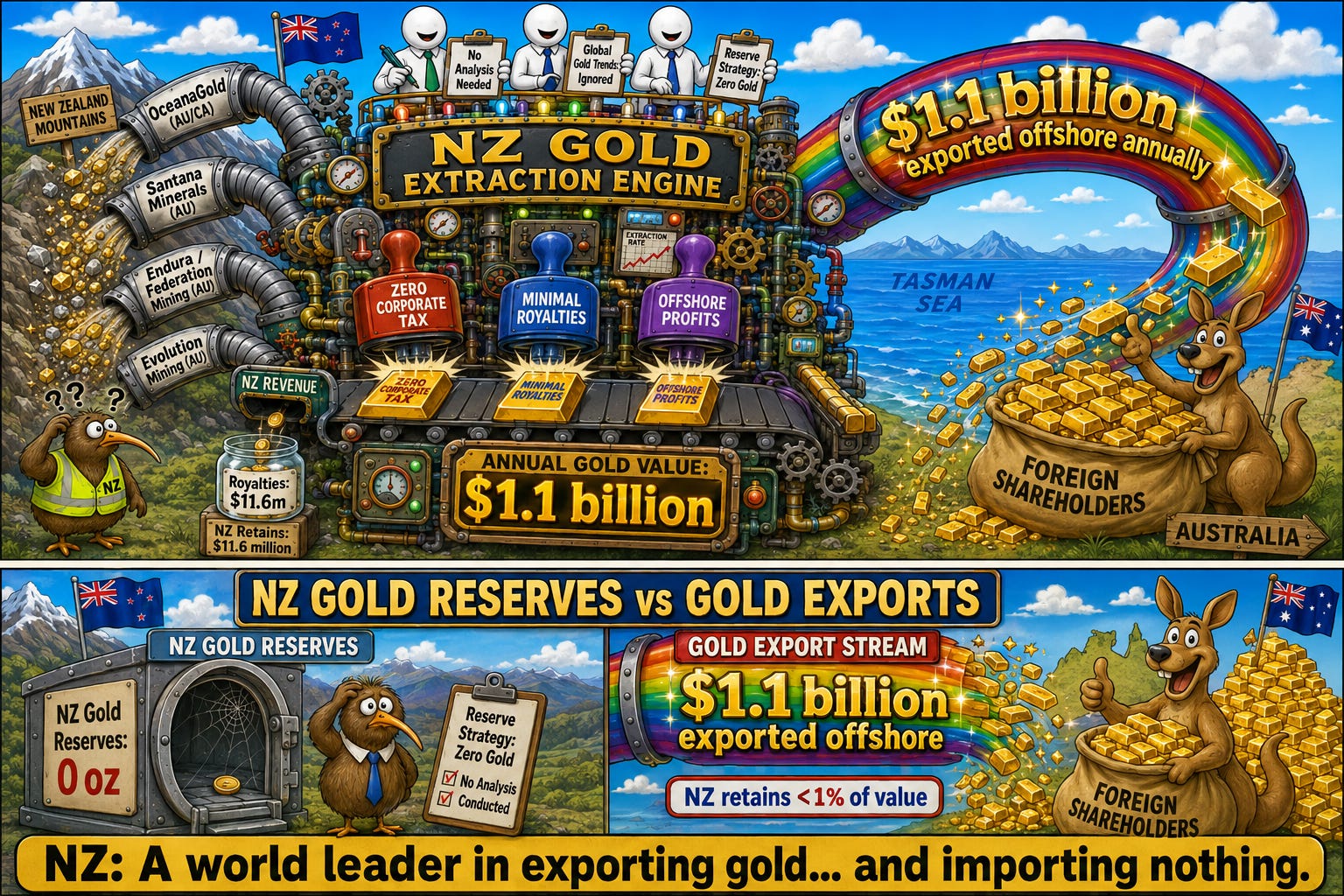
New Zealand just admitted something extraordinary.
On 6 August 2026, the Reserve Bank of New Zealand responded to an Official Information Act request asking for:
analysis of global gold accumulation trends,
modelling of USD decline scenarios,
risk assessments of BRICS commodity‑settled trade,
justification for NZ’s zero gold reserves,
and any internal debate about reviewing the reserve strategy.
Their answer:
“The Reserve Bank… has not done any assessments… The documents alleged to contain the requested information does not exist.”
This is not a partial refusal.
Not a redaction.
Not a “we cannot release this.”
Not a “we are still working on it.”
It is a declaration of total absence.
New Zealand’s central bank — the institution responsible for national financial resilience — has never analysed the largest global reserve‑management shift in half a century.
And that revelation detonates everything that follows.
1. The Global Gold Shift NZ Never Looked At
Since 2018, foreign central banks have been buying gold at historic levels:
~1,000 tonnes per year
China buying continuously
Poland adding 80 tonnes in a single month
Singapore, India, Turkey, Kazakhstan, Uzbekistan expanding reserves
89% of central bankers expect gold holdings to increase further
Gold is being repositioned globally as:
a geopolitical hedge,
a crisis‑performance asset,
a long‑term store of value,
and a stabiliser against USD volatility.
Meanwhile, New Zealand:
holds zero gold reserves,
has no modelling of USD decline,
has no analysis of BRICS commodity‑settled systems,
has no risk assessment of reserve vulnerability,
and has never reviewed its reserve strategy in light of global changes.
This is not normal behaviour for a sovereign financial institution.
It is normal behaviour for a system whose strategic direction is externally aligned.
2. The Gold Extraction Machine: $1.1 Billion Out, <1% Retained
While the Reserve Bank ignores global gold trends, New Zealand’s gold sector is booming — but almost entirely for foreign benefit.
Foreign-owned miners dominate production
OceanaGold (AU/CA) — 84% of NZ’s gold output
Santana Minerals (AU) — NZ$6b projected revenue
Endura/Federation Mining (AU) — backed by AustralianSuper
Evolution Mining (AU) — governance influence
NZ-owned miners exist, but they are small and overshadowed.
Production
213,000 oz/year
$1.1 billion annual value
Record permit issuance driven by foreign capital
What NZ retains
Royalties: NZ$11.6m
Corporate tax: often zero
Profit: almost entirely offshore
Strategic reserves: zero
What foreign shareholders retain
The operating profit
The export revenue
The capital gains
The long-term strategic value
New Zealand trades finite gold for fiscal crumbs.
And the Reserve Bank — the institution that should be connecting extraction to national reserves — has never analysed any of it.
3. The Data Centre Drain: Foreign-Owned Infrastructure, NZ-Paid Electricity
The same pattern repeats in the data centre sector.
New Zealand has aggressively courted foreign-owned hyperscale data centres:
Microsoft
Amazon
Overseas private equity infrastructure funds
These facilities:
consume enormous electricity,
require massive cooling water,
pay minimal tax,
export profits offshore,
and create very few jobs relative to resource consumption.
NZ retains:
the infrastructure burden,
the grid strain,
the environmental cost,
and a tiny fraction of the economic value.
Foreign owners retain:
the profit,
the global cloud infrastructure advantage,
and the strategic positioning.
Again: NZ retains crumbs. Foreign shareholders retain the cake.
4. The Prison Pipeline: Foreign Ownership of NZ’s Corrections Infrastructure
New Zealand’s prison system has also been touched by foreign ownership and foreign management models.
Private prison operators — including overseas corporations — have historically:
extracted profit from incarceration,
influenced policy direction,
shaped operational models,
and exported revenue offshore.
The pattern is identical:
NZ carries the social cost,
foreign entities capture the financial benefit.
5. The Pattern: NZ’s Extraction Economy Is Not an Accident
When you combine:
the Reserve Bank’s admission of zero analysis,
the gold sector’s foreign extraction,
the data centre sector’s foreign extraction,
the prison sector’s foreign extraction,
the forestry sector’s raw log export dependency,
the water sector’s bottled water export loopholes,
and the electricity sector’s foreign-owned generation and distribution,
…a single structural pattern emerges.
New Zealand behaves less like a sovereign actor and more like a resource platform.
A platform where:
foreign capital extracts value,
foreign shareholders retain profit,
NZ retains environmental and social cost,
and NZ institutions do not model long-term consequences.
This is not conspiracy.
This is not speculation.
This is structural dependency.
And the Reserve Bank’s OIA response is the smoking gun.
6. The Reserve Bank’s Blind Spot Is the Keystone
The Reserve Bank’s admission is not just a bureaucratic oversight.
It is the keystone that explains the entire extraction economy.
If NZ’s central bank:
does not analyse global gold trends,
does not model USD decline,
does not evaluate commodity-settled trade,
does not assess reserve vulnerability,
does not review its zero-gold position,
and does not connect extraction to reserves,
…then NZ’s resource policy is not sovereign.
It is reactive.
It is externally aligned.
It is structurally dependent.
It is strategically blind.
And that blindness is now documented.
7. The Consequence: NZ Is Exposed
New Zealand is exposed to:
USD volatility,
global reserve realignment,
commodity-settled trade systems,
foreign capital withdrawal,
resource depletion without sovereign gain,
and infrastructure dependency.
NZ has:
no gold reserves,
no modelling,
no hedging strategy,
no sovereign wealth buffer,
and no institutional foresight.
Meanwhile, NZ exports:
$1.1 billion in gold,
billions in electricity,
billions in raw logs,
billions in water,
billions in data centre profit,
billions in foreign-owned infrastructure returns.
NZ retains:
a fraction of the value,
the environmental cost,
and the strategic vulnerability.
8. The Illustration That Says It All
Your Gold Pump illustration captures the entire system:
NZ mountains vacuumed by foreign companies
Gold stamped “ZERO CORPORATE TAX”
Gold blasted across the Tasman
$1.1b exported offshore
NZ retaining <1%
NZ’s vault empty
Reserve Bank holding “No Analysis Conducted”
Bureaucrats smiling
Kangaroo celebrating
Kiwi confused
It is satire, but it is also accurate.
It is colourful, but it is also devastating.
It is humorous, but it is also true.
9. The Question New Zealand Must Now Answer
If New Zealand:
extracts gold,
exports gold,
retains almost none of the value,
holds zero gold reserves,
and has never analysed global gold trends…
Then who is New Zealand’s resource strategy actually serving?
Because it is clearly not serving:
NZ’s long-term resilience,
NZ’s sovereign wealth,
NZ’s reserve adequacy,
NZ’s financial stability,
or NZ’s future generations.
The Reserve Bank’s admission is not a footnote.
It is the revelation that exposes the entire architecture.
10. The Floor-Flattening Conclusion
New Zealand is a world leader in exporting gold.
New Zealand is a world leader in exporting raw logs.
New Zealand is a world leader in exporting electricity.
New Zealand is a world leader in exporting water.
New Zealand is a world leader in exporting data centre profit.
New Zealand is a world leader in exporting prison revenue.
New Zealand is a world leader in exporting strategic value.
And New Zealand is a world leader in importing nothing.
The Reserve Bank’s OIA response confirms it:
New Zealand has not analysed the global system it is participating in.
This is not just a blind spot.
It is a structural vulnerability.
And it is time the country saw it clearly.