 iSAYSO
When Treatment Isn’t Complete: What the Definition of Medicine Reveals About New Zealand’s Health System
When Treatment Isn’t Complete: What the Definition of Medicine Reveals About New Zealand’s Health System
By Nigel Gray 3 August 2026 PLEASE SHARE!
The public assumes something very simple about healthcare:
If you are prescribed a medication, the treatment you receive will be complete, and your health will be maintained.
That assumption is not only reasonable — it is embedded in the very definition of medicine itself:
Medicine is the science and art of diagnosing and treating disease or injury and maintaining health.
This definition is not decorative.
It is the foundation of medical ethics, medical training, and medical responsibility.
But an Official Information Act (OIA) response released this week reveals something the public has never been told:
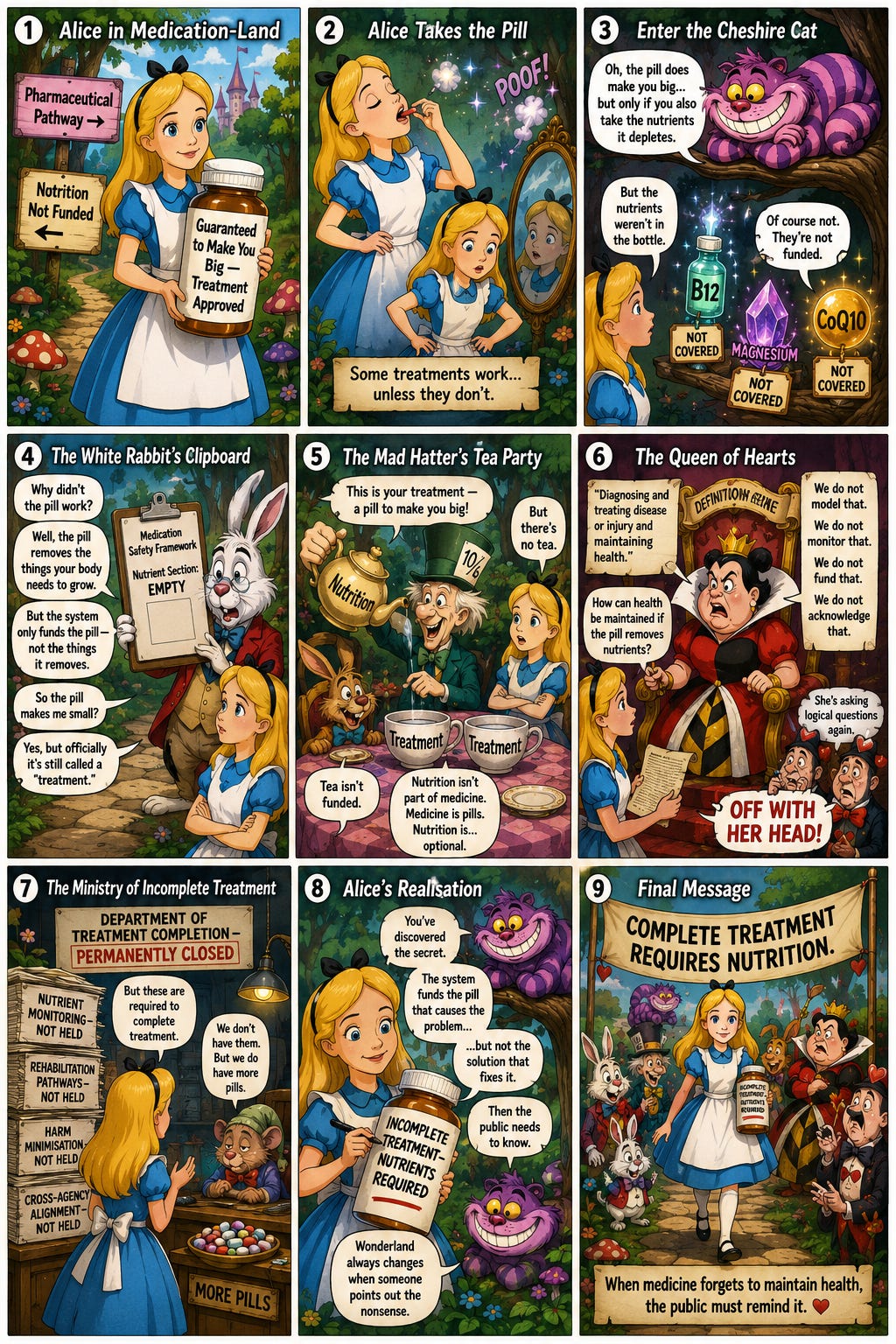
New Zealand’s health system funds medications that deplete essential nutrients — but does not fund, monitor, or model the correction of those depletions.
This means treatment is routinely left incomplete, and the obligation to maintain health is not being met.
And until now, no one has asked the system to explain this contradiction.
The Hidden Gap: Medication Without Nutrient Restoration
Many common medications deplete essential nutrients:
Metformin → B12
Proton pump inhibitors → magnesium
Statins → CoQ10
Diuretics → potassium & magnesium
Anticonvulsants → vitamin D
Oral contraceptives → B6, folate, magnesium
These are not fringe claims.
They are documented in pharmacology textbooks, Medsafe data sheets, and international clinical guidelines.
Yet the OIA response from Health NZ confirms:
There are no national systems, no modelling frameworks, and no monitoring structures for medication‑induced nutrient depletion.
No rehabilitation pathways exist.
No harm‑minimisation frameworks exist.
No national guidance exists.
This is not a small administrative oversight.
It is a structural gap in the very concept of treatment.
Why This Matters: Treatment Must Be Complete
If a medication depletes a nutrient required for recovery, then nutrient restoration is not optional — it is part of the treatment.
Without it:
biochemical pathways fail
symptoms worsen
withdrawal becomes harder
recovery is delayed
secondary conditions appear
long‑term harm accumulates
A treatment that creates a secondary condition is not complete unless the secondary condition is corrected.
This is not philosophy.
It is physiology.
Yet New Zealand’s health system behaves as if:
medication = treatment
nutrition = optional lifestyle advice
The OIA response confirms this classification repeatedly:
“Nutritional requirements… are managed within clinical specialties.”
“No national-level modelling exists.”
“No national analysis exists.”
“Information requested is not held.”
In other words:
The system funds the cause of nutrient depletion, but not the correction required to complete treatment.
The Definition of Medicine Creates an Obligation — and the System Is Not Meeting It
Let’s apply the definition directly.
1. Diagnosing disease
Nutrient depletion caused by medication is a diagnosable biochemical condition.
But the system does not diagnose it.
2. Treating disease or injury
Medication-induced nutrient depletion is a treatment‑induced injury.
But the system does not treat it.
3. Maintaining health
Nutrients are required to maintain health.
But the system does not monitor or restore them.
This means:
The health system is not fulfilling the definition of medicine.
And the public has never been told.
The Funding Contradiction
The OIA response reveals a stark asymmetry:
Medications are funded.
Nutrient restoration is not funded.
Why?
Because medications are classified as “treatments,” while nutrition is classified as “support.”
This classification is scientifically false and administratively convenient.
It allows the system to:
fund medications
ignore nutrient depletion
avoid monitoring
avoid responsibility
avoid modelling
avoid rehabilitation
avoid cross‑agency alignment
avoid funding the correction of harm
This is not a clinical decision.
It is a policy decision.
And it leaves treatment incomplete.
The Public Impact
This affects:
anyone on long‑term medication
anyone coming off medication
anyone with unexplained symptoms
anyone experiencing withdrawal
anyone with chronic fatigue, neuropathy, muscle weakness, or cognitive decline
anyone who trusted the system to maintain their health
When nutrient depletion is not monitored or corrected, patients are left with:
deteriorating health
preventable symptoms
preventable harm
preventable disability
preventable suffering
And they are left to pay for the correction themselves — if they even know what is happening.
Why This OIA Matters
For the first time, the system has been asked:
How do you ensure treatment is complete when medications deplete nutrients?
How do you maintain health when medications remove what the body needs to stay healthy?
What systems exist to prevent medication-induced nutrient depletion from becoming unfunded harm?
The OIA response shows:
no systems exist
no modelling exists
no monitoring exists
no pathways exist
no frameworks exist
no national guidance exists
This is not a minor gap.
It is a structural failure.
And now it is public.
What Happens Next
Raising public awareness is the first step.
Once the public understands that treatment is being left incomplete, pressure builds for:
national nutrient monitoring
funded nutrient restoration
medication safety reform
cross‑agency harm modelling
updated clinical guidelines
transparent reporting
accountability
This is how systems change begins.
And it begins with a simple question:
If medicine must maintain health, why does the system fund medications that deplete nutrients — but not the nutrients required to maintain health?
The public deserves an answer.