 iSAYSO
Health NZ Confirms New Zealand Has No System for Tracking Medication Exposure in Suicide Cases
Nigel’s Substack
The Missing Data: Health NZ Confirms New Zealand Has No System for Tracking Medication Exposure in Suicide Cases
The Missing Data: Health NZ Confirms New Zealand Has No System for Tracking Medication Exposure in Suicide Cases
BY NIGEL GRAY 25 JULY 2026



New Zealand’s suicide‑reporting system has a blind spot so large it borders on systemic negligence: no agency in the country collects, analyses, or even discusses whether people who die by suicide were taking prescribed medication — including medicines with known risks of aggression, akathisia, behavioural toxicity, self‑harm, or suicidality.
A new OIA response from Health New Zealand (HNZ00204182, 29 June 2026) confirms this with stark clarity.
And the implications are profound.
1. The Admission: “No documents exist.”
Health NZ’s response states:
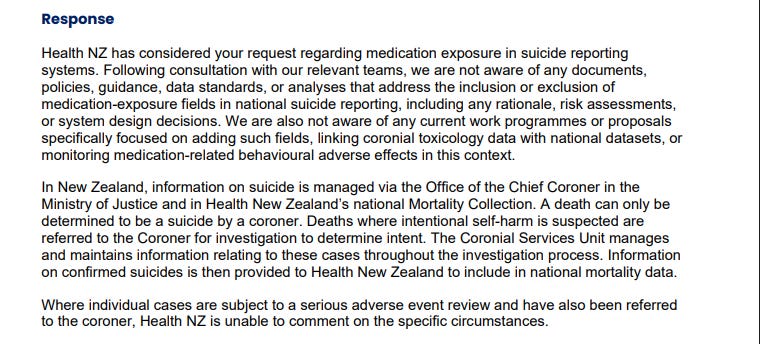
“We are not aware of any documents, policies, guidance, data standards, or analyses that address the inclusion or exclusion of medication‑exposure fields in national suicide reporting…”
“Health NZ also confirms it does not hold a national dataset capturing whether individuals who died by suicide were taking, starting, stopping, or changing prescribed medications.”
This is not a minor administrative oversight.
It is a structural void.
Across suicide surveillance, coronial reporting, mortality datasets, and adverse‑event systems, medication exposure is simply not recorded — not as a mandatory field, not as an optional field, not even as a “considered but rejected” field.
There is no policy.
No rationale.
No risk assessment.
No system‑design history.
No future plan.
No inter‑agency discussion.
Nothing.
2. Why This Matters: The Known Risks
Many commonly prescribed medications carry explicit warnings for:
aggression
akathisia
behavioural toxicity
self‑harm
suicidal thoughts or actions
These warnings exist because the risks are real.
Yet New Zealand’s suicide‑reporting system does not track whether the deceased was:
taking medication,
recently started medication,
recently stopped medication, or
undergoing dose changes.
This omission makes it impossible to evaluate medication‑related behavioural adverse effects at a population level.
It also means New Zealand cannot:
detect medication‑linked suicide clusters,
identify high‑risk prescribing patterns,
evaluate pharmacovigilance signals, or
inform suicide‑prevention policy with complete data.
3. The System Design Problem: No One Decided — It Just Never Happened
The OIA confirms:
“We are not aware of any system‑design decisions… any consultations… any evaluations of the impact of this omission…”
This is not a deliberate policy choice.
It is an absence of policy.
A gap that persisted because no one ever built the field, required the field, or asked why the field wasn’t there.
The Coronial Services Unit does not collect it.
The Suicide Prevention Office does not collect it.
Medsafe does not collect it.
Health NZ does not collect it.
The Ministry of Justice does not collect it.
And because no one collects it, no one analyses it.
And because no one analyses it, no one sees the problem.
This is how systemic blind spots survive.
4. The Consequence: Suicide Data Without Context
New Zealand’s national suicide statistics are treated as authoritative.
They inform policy, media reporting, public debate, and mental‑health strategy.
But without medication‑exposure data, they are context‑blind.
A suicide dataset without medication status is like a road‑fatality dataset that omits whether the driver was intoxicated.
It is incomplete by design.
5. The Future: No Work Programme, No Plan, No Movement
Health NZ confirms:
“We are not aware of any current work programmes or proposals focused on adding such fields, linking coronial toxicology data, or monitoring medication‑related behavioural adverse effects.”
This means:
No upcoming reforms
No planned improvements
No inter‑agency coordination
No pharmacovigilance integration
No suicide‑prevention enhancements
The system is static.
6. The Most Concerning Line
The response concludes:
“Your request is refused under section 18(e)… the information requested does not exist.”
This is not just an OIA refusal.
It is a statement about the architecture of New Zealand’s suicide‑monitoring system:
The information does not exist because the system was never designed to produce it.
7. What This Means for Public Health
Without medication‑exposure data:
Suicide‑prevention policy is built on partial evidence.
Pharmacovigilance cannot detect behavioural toxicity signals.
Coronial investigations lack structured medication fields.
Mental‑health services cannot evaluate treatment‑related risks.
Researchers cannot study medication‑linked suicide patterns.
The public cannot see the full picture.
This is not a data gap.
It is a systemic failure of surveillance.
8. What Happens Next
This OIA response is now part of the public record.
It raises questions that cannot be ignored:
Why was medication exposure never included?
Who should be responsible for fixing this?
How many suicides involved medication‑related behavioural adverse effects?
How can suicide‑prevention policy be evidence‑based without this data?
Why does New Zealand’s system lag behind international best practice?
These questions now belong to the public, the media, and the agencies responsible for suicide prevention.
9. Closing Reflection
New Zealand has built a suicide‑reporting system that cannot see one of the most clinically significant risk factors.
This is not a criticism of frontline clinicians or coronial investigators.
It is a critique of system design — or more accurately, system non‑design.
The absence of medication‑exposure data is not neutral.
It shapes what we can know, what we can prevent, and what we can learn.
And until this gap is addressed, New Zealand’s suicide statistics will remain incomplete.