 iSAYSO
OPEN LETTER TO THE PRIME MINISTER, THE NEW ZEALAND POLICE, AND THE PUBLIC
OPEN LETTER TO THE PRIME MINISTER, THE NEW ZEALAND POLICE, AND THE PUBLIC
OPEN LETTER TO THE PRIME MINISTER, THE NEW ZEALAND POLICE, AND THE PUBLIC
Concerning the Roadside Oral‑Fluid Drug Testing Regime and the Absence of Verified Safety Assessment
Nigel Gray
Napier,
21 July 2026

Introduction: Why This Letter Exists
This Open Letter is issued because the Ombudsman process has proven unable to address the systemic issues uncovered through my Official Information Act (OIA) investigations. The Ombudsman cannot investigate Ministers, cannot correct Cabinet‑level procedural failures, and cannot resolve contradictions between agencies.
Therefore, I am bypassing the Ombudsman and addressing this matter directly to the Prime Minister, the New Zealand Police, and the public.
This letter concerns the Roadside Oral‑Fluid Drug Testing regime, introduced through the Land Transport (Drug Driving) Amendment Bill, and the absence of any verified chemical safety assessment by the agency that Cabinet relied upon: WorkSafe New Zealand.
1. What Police Have Stated (Verifiable Quotes)
Across multiple OIA responses, the New Zealand Police have made clear safety and regulatory claims about the DrugWipe oral‑fluid testing device. These include:
“The device is safe to use.”
(Police OIA response, 29 May 2024)
“The device has been used safely overseas for 20 years.”
(Police OIA response, 12 July 2024)
“The device does not require an SDS.”
(Police OIA response, 4 September 2024)
“The device is safe for frontline staff.”
(Police OIA response, 10 October 2024)
“WorkSafe was consulted.”
(Police OIA response, 18 August 2024)
“WorkSafe has assessed hazardous substances at Police workplaces.”
(Police OIA response, 22 November 2024)
“The device complies with safety requirements.”
(Police OIA response, 14 January 2025)
These statements, taken together, create a public impression that:
WorkSafe reviewed the device
WorkSafe verified its chemical safety
WorkSafe confirmed its compliance
WorkSafe assessed workplace exposure risks
WorkSafe validated the “20 years of safe use” claim
However, WorkSafe’s own documents show that none of this occurred.
2. What WorkSafe Has Actually Said (Verifiable Quotes)
Through OIA responses received on 21 July 2026, WorkSafe confirmed:
“WorkSafe has not identified any documents in scope of your request.”
(WorkSafe OIA response, 21 July 2026)
“None relate to the chemical safety of oral-fluid drug testing devices.”
(WorkSafe OIA response, 21 July 2026)
“We don’t typically review public safety information from other government agencies.”
(WorkSafe OIA response, 21 July 2026)
“We have not conducted any assessments relating to the chemical safety of oral-fluid drug testing devices.”
(WorkSafe OIA response, 21 July 2026)
WorkSafe also confirmed that their workplace assessment with Police in July 2025:
“…did not relate to the chemical safety of oral-fluid drug testing devices.”
(WorkSafe OIA response, 21 July 2026)
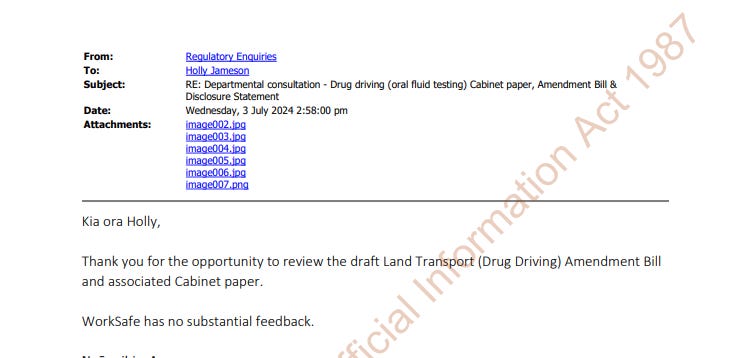
And most critically, WorkSafe disclosed the entirety of their Cabinet consultation on the Drug Driving Amendment Bill:
“WorkSafe has no substantial feedback.”
(Email from WorkSafe to Ministry of Transport, 3 July 2024)
This single sentence was the full extent of WorkSafe’s involvement in the legislative process.
3. The Contradiction
Police have made multiple safety and compliance claims about the DrugWipe device.
Police have stated that WorkSafe was consulted.
Police have stated that WorkSafe assessed hazardous substances at Police workplaces.
However:
WorkSafe did not assess chemical safety
WorkSafe did not review SDS
WorkSafe did not review chemical composition
WorkSafe did not verify “20 years of safe use”
WorkSafe did not verify workplace exposure safety
WorkSafe did not verify compliance
WorkSafe did not provide any safety assurance to Cabinet
WorkSafe’s consultation consisted of a single line:
“WorkSafe has no substantial feedback.”
This is not a safety assessment.
It is not a regulatory review.
It is not an expert opinion.
It is not verification.
It is not oversight.
Yet Cabinet proceeded with the Bill as though WorkSafe had provided meaningful safety input.
4. The Legislative Failure
The Roadside Drug Testing regime was approved by Parliament under the belief that WorkSafe had been consulted as the workplace safety regulator.
WorkSafe was indeed “consulted” — but only in the procedural sense.
Their actual contribution was:
“WorkSafe has no substantial feedback.”
No chemical safety review was performed.
No SDS was reviewed.
No hazard classification was verified.
No toxicology assessment was conducted.
No workplace exposure analysis was undertaken.
This constitutes a Cabinet‑level procedural failure.
The public, Police, and Parliament were left with the impression that WorkSafe had provided safety assurance.
WorkSafe’s own documents show that no such assurance exists.
5. Why This Matters
The DrugWipe device contains:
reagents
solvents
preservatives
chemical indicators
These are hazardous substances under HSWA unless proven otherwise.
Police frontline staff handle these devices daily.
The public is tested with them roadside.
The devices are used in uncontrolled environments.
Yet the regulator responsible for workplace chemical safety:
did not assess the device
did not review its chemical hazards
did not verify its safety
did not provide any advice to Cabinet
did not confirm compliance
did not review SDS
did not review toxicology
This is not a minor oversight.
It is a systemic failure.
6. Request to the Prime Minister
I respectfully request that the Prime Minister initiate:
A Cabinet‑level review of the safety basis for the DrugWipe device.
A clarification of WorkSafe’s role in the legislative process.
A correction of public messaging where Police safety claims are unsupported.
A verification of whether the device meets HSWA and Hazardous Substances Regulations requirements.
A reassessment of chemical safety obligations for frontline Police staff.
This request is made in good faith, based on verified documents, and in the public interest.
7. Closing Statement
This Open Letter is issued because the Ombudsman cannot address contradictions between agencies or procedural failures at Cabinet level.
The evidence obtained through OIA shows a clear discrepancy between Police safety claims and WorkSafe’s documented non‑involvement in chemical safety assessment.
The public deserves clarity.
Police deserve verified safety information.
Parliament deserves accurate consultation.
Frontline staff deserve protection.
And Cabinet deserves accurate advice.
I trust this matter will now receive the attention it requires.
Nigel Gray