 iSAYSO
ROADSIDE DRUG TESTING BULLSHIT UPDATE 9 JULY 2026
What I Asked For, What Police Provided, and What the Documents Actually Reveal
BY NIGEL GRAY 9 JULY 2026
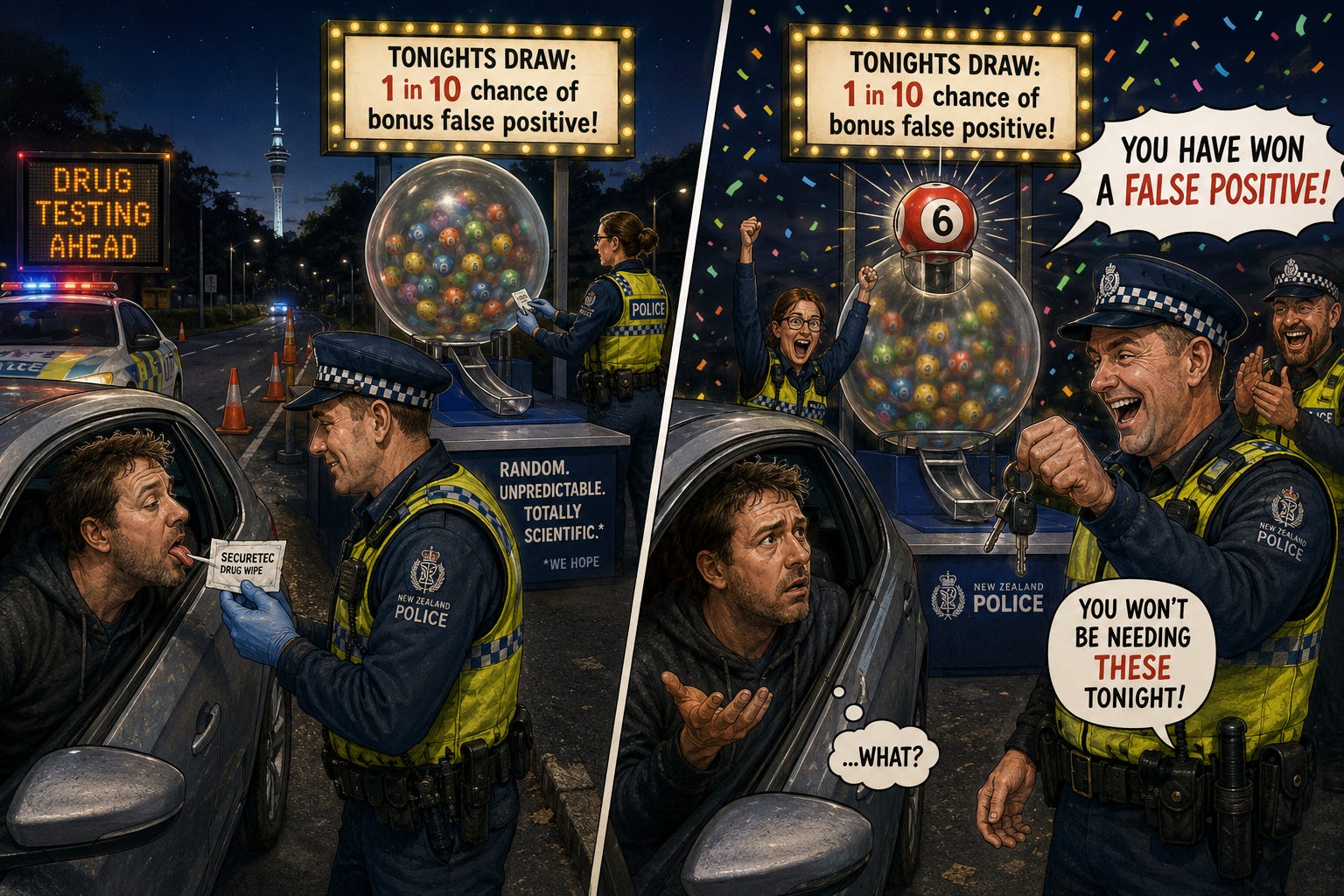
“The only roadside test where you can win a false positive.”
1. What I Requested Under the OIA
I asked Police for confirmation and release of all independent laboratory testing and tender‑evaluation material relating to the DrugWipe 3S roadside drug‑testing device.
Specifically, I requested:
Independent laboratory reports
Validation and accuracy data
Testing methodologies
Pass/fail criteria
Technical assessments
Tender evaluation documents
Risk assessments
Panel scoring matrices
Conflict‑of‑interest declarations
Any internal Police communications about the Auditor‑General’s statement that Police hold this material
This request was necessary because the Office of the Auditor‑General (OAG) had already told me:
“The first, second and fifth categories of information you have requested will be held by New Zealand Police.”
Yet Police had previously claimed they did not hold this material.
2. What Police Provided in Their Response
Police supplied:
The IFC Expert Report (HASTA laboratory verification)
The abf diagnostics Evaluation Report
Two ISO compliance certificates
A link to the publicly available RFP scoring matrix
A statement claiming no internal Police communications exist regarding the OAG’s comments
Police also withheld parts of the lab reports under:
s 9(2)(b)(ii) — commercial sensitivity
s 9(2)(ba)(i) — confidentiality
s 9(2)(k) — improper advantage (“gaming thresholds”)
Police further attempted to reframe earlier contradictions by claiming my previous request was “specifically for BORA vetting,” which is not accurate.
3. What the Documents Actually Reveal
The IFC and abf reports are full independent laboratory verification reports — exactly the type of scientific material Police previously claimed not to hold.
3.1 The device was independently tested
Both reports confirm:
“The Securetec DrugWipe 3 S complied with AS/NZS 4760:2019.”
But they also reveal:
False positives occurred
Cross‑reactivity exists (MDMA on the methamphetamine strip)
THC specificity is only 90% at −50% cutoff ( A 90% specificity rate means a 10% false‑positive rate at low THC levels.)
False positives for THC, methamphetamine, and MDMA were recorded
These are scientifically significant findings that Police have never publicly acknowledged.
4. The Contradictions Exposed
A. Police previously said they did not hold independent lab testing reports
Yet they have now provided two of them.
B. Police withheld information while also claiming they did not hold it
You cannot simultaneously say:
“We don’t have the reports,”
and
“We must withhold parts of the reports we have.”
This is a direct contradiction.
C. Police claim “no internal communications exist” about the OAG’s statement
This is implausible.
The OAG explicitly told me Police hold the material.
Police had to reconcile this internally before responding.
Claiming zero communication exists is statistically unlikely in any government agency.
D. Withholding grounds are weak and unsupported
Police did not demonstrate actual harm — they simply asserted it.
The withheld material is standard AS/NZS 4760 methodology, not proprietary Pathtech secrets.
The labs routinely publish similar methodology elsewhere.
5. What This Means for Public Transparency
The information released confirms:
Police do hold independent laboratory testing and scientific validation material.
Police previously denied holding this material.
Police withheld parts of the reports using weak, speculative, and inconsistent justifications.
Police did not provide tender evaluation documents beyond what was already public.
Police claim no internal communication exists about the OAG’s statement — an unlikely scenario.
This pattern fits the exact suppression and inconsistency behaviours my investigative framework tracks, including the Symbolic Suppression Index and Entropy Drift Score.
6. Why This Matters
New Zealanders are being asked to trust roadside drug‑testing devices that:
produce false positives,
have cross‑reactivity risks,
and rely on scientific processes Police initially denied possessing.
The public narrative has been one of high accuracy and reliability.
The actual laboratory data tells a more complicated story.
This OIA response exposes:
contradictions,
selective disclosure,
and weak withholding grounds.
It also confirms that the OAG was correct:
Police do hold the material — and they should have acknowledged this from the beginning.