 iSAYSO
Incentives for Drug Testing Refusals: The Police Funding Model for Success
Incentives for Drug Testing Refusals: The Police Funding Model for Success
By Nigel Gray 2 July 2026
Preface
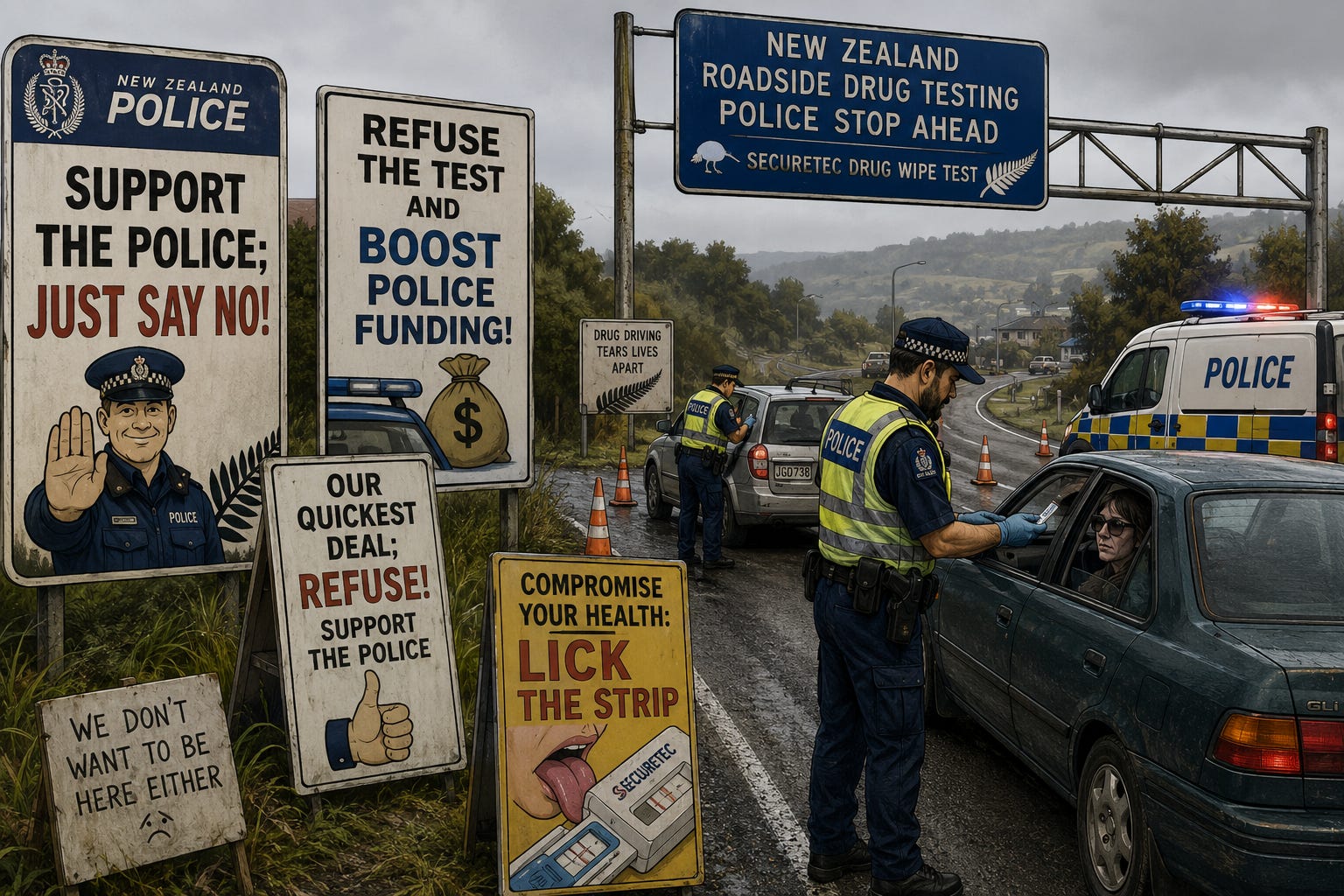
The Road Policing Investment Programme (RPIP) 2024–27 does not explicitly reward Police when drivers refuse drug tests. However, the programme’s funding structure, performance expectations, and deterrence‑driven operational logic create structural incentives that favour high‑volume testing, visible enforcement, and procedural throughput. Within that environment, refusal becomes an administratively efficient outcome — not because it is sought, but because it aligns with the system’s measurable outputs.
This article outlines how those structural incentives arise, how they shape frontline behaviour, and why refusal can become operationally convenient despite the absence of any direct financial benefit.
The Funding Model: Activity Over Accuracy
The RPIP funds Police based on activity outputs, not accuracy outcomes.
Funded activities include:
Visible enforcement
High‑coverage roadside screening
Deterrence presence
Risk‑based targeting
These activities are counted, reported, and used to justify funding.
What is not measured:
accuracy of impairment assessment
scientific reliability of testing
minimisation of false positives
rights‑protection or proportionality
quality of officer decision‑making
When a system rewards doing more, not doing better, behaviour follows the incentives.
Deterrence as a Performance Expectation
The RPIP repeatedly emphasises the importance of perceived likelihood of being caught.
This is framed as a Key Performance Indicator (KPI) — spelled out in full as Key Performance Indicator, not just the acronym — and it drives a particular style of policing.
What this means in practice
more stops = stronger deterrence
more tests = stronger deterrence
more prohibitions = visible action
more roadside activity = measurable success
Under this logic, officers are incentivised to maximise interactions, not to evaluate impairment.
Refusal becomes just another “visible enforcement outcome.”
Throughput Incentives: Why Refusal Is Operationally Convenient
Although refusal is not financially rewarded, it is procedurally efficient.
A refusal:
ends the interaction immediately
avoids the second oral fluid test
avoids evidential blood testing
avoids laboratory processing
avoids waiting for results
avoids complex paperwork
produces an instant prohibition
counts as a “successful enforcement action”
In a system driven by volume, visibility, and deterrence, refusal is the fastest path to a measurable output.
This is not corruption — it is structural bias created by the funding model.
No Key Performance Indicator for Accuracy or Rights
The RPIP contains no Key Performance Indicator for:
correct identification of impairment
minimising unnecessary detentions
ensuring scientific reliability
protecting due process
reducing false positives
ensuring proportionality
When a system lacks metrics for fairness, fairness becomes optional.
When a system rewards throughput, throughput becomes the priority.
Risk‑Based Targeting and the Blanket‑Testing Effect
The RPIP encourages Police to focus on:
high‑risk corridors
high‑risk groups
high‑risk behaviours
This often results in blanket testing, especially in:
rural freight routes
nightlife zones
festival environments
checkpoints
Blanket testing increases:
the number of interactions
the number of tests
the number of prohibitions
the number of refusals
Refusal becomes a predictable by‑product of a high‑volume strategy.
The Absence of Downside: Why Officers Can Escalate Freely
The RPIP does not penalise:
unnecessary escalation
misinterpretation of faint lines
over‑testing
procedural rigidity
ignoring contextual impairment cues
With no downside for escalation, and clear upside for activity, officers naturally gravitate toward more testing, not more discernment.
The Systemic Outcome: A Culture of Procedural Maximisation
When you combine:
activity‑based funding
deterrence‑based Key Performance Indicators
visibility‑based performance expectations
risk‑based targeting
no accuracy metrics
no rights‑protection metrics
operational convenience of refusal
You get a system where:
refusal is not incentivised financially
refusal is incentivised structurally
The RPIP does not say “prefer refusals.”
But the system it creates makes refusals easier, faster, and more aligned with funded outputs.
Why This Matters
The public is told the drug‑testing regime is about:
impairment
safety
science
fairness
But the funding model is about:
numbers
visibility
throughput
deterrence
This mismatch creates predictable distortions in frontline behaviour.
Understanding these incentives is essential for:
legislative review
public accountability
Ombudsman oversight
rights‑based advocacy
scientific scrutiny of testing devices
Conclusion
There is no explicit incentive for Police to prefer drug‑test refusals.
But the RPIP’s architecture creates implicit incentives that make refusal:
administratively efficient
operationally convenient
aligned with funded outputs
consistent with deterrence logic
In a system built on activity, visibility, and throughput, refusal becomes a structurally favoured outcome — not because Police want it, but because the funding model rewards the behaviours that make it more likely.